AI for Insurance Claims Processing: 2026 Trends and the Conversational FNOL Shift
TL;DR
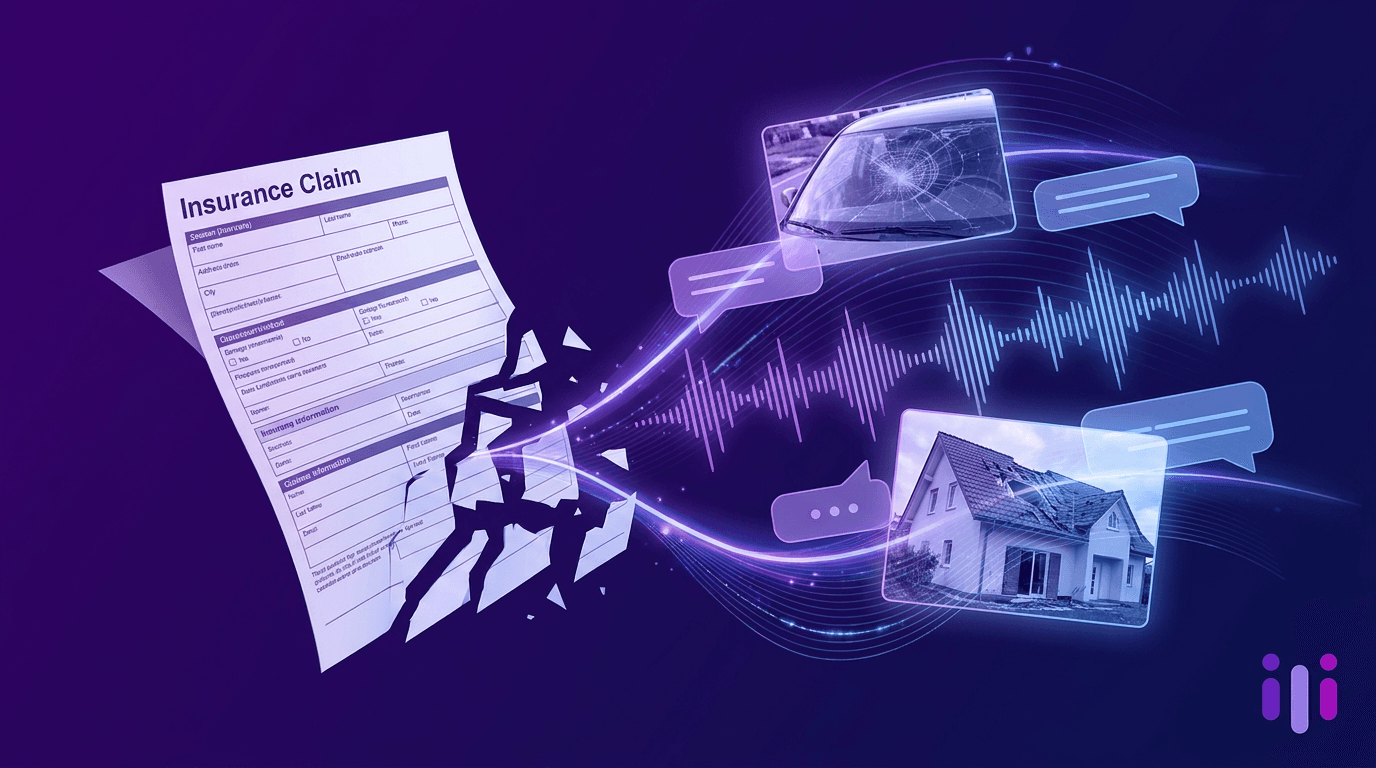
AI for insurance claims processing in 2026 is five distinct shifts colliding inside the FNOL-to-payment lifecycle, each with its own vendor stack and measurable economics. Computer-vision damage models from Tractable and CCC Intelligent Solutions now triage auto claims in seconds — Tractable handles roughly $2 billion in vehicle repairs annually across 35-plus of the world's top 100 carriers. Conversational FNOL is replacing IVR menus and PDF forms via voice-first AI agents from Hi Marley, Liberate, and Five Sigma. Automated subrogation engines are closing a $15 billion annual recovery gap the NAIC has identified, with vendor data showing 20–40% recovery lift and 50–70% pursuit-cost reduction. Multimodal fraud detection is shifting from rules to interview-audio analysis — synthetic voice attacks rose 19% in 2024. Claims-status conversations are replacing the "where is my check?" queue. Aviva's partnership with McKinsey's QuantumBlack deployed 80-plus AI models and cut complex liability assessment by 23 days, improved routing accuracy 30%, and dropped complaints 65%. Accenture warns $170 billion in premium is at risk over five years from claims-experience defection. Perspective AI's conversational interview infrastructure powers the FNOL and post-resolution layers — capturing the "why" in policyholders' own words rather than dropdowns.
What's Driving AI for Insurance Claims Processing in 2026
AI for insurance claims processing in 2026 is being driven by three converging forces: large language models that finally handle free-form loss descriptions, computer-vision models trained on hundreds of millions of historical claim images, and a claims-experience cliff carriers can no longer ignore. Accenture's 2025 survey found 86% of insurance organizations plan to increase AI spending in 2026, with generative and agentic AI topping the investment list. Research and Markets sized the AI claims processing market at $0.53 billion in 2026 with a 16.4% CAGR, while Fortune Business Insights projects the broader AI in insurance market expanding from $13.45 billion to $154.39 billion by 2034. According to a McKinsey analysis, gen AI alone could unlock $50–$70 billion of insurance revenue, with AI leaders generating roughly 6x the total shareholder returns of their laggard peers.
Each shift below covers what's changing, the evidence, why it matters, and what to do. For broader operating-model context, our 2026 state-of-the-industry report on AI customer communications in insurance is the companion read.
Shift 1: Photo Damage Models Have Reached Production Scale
Computer-vision damage assessment is the most mature AI-for-claims category. Tractable's pixel-level damage models cover 80-plus vehicle panels and parts in the US, generate certainty scores per estimate, and are used by 35-plus of the world's top 100 insurance carriers, processing roughly $2 billion in annual vehicle repairs. CCC Intelligent Solutions disclosed in its Q1 2026 earnings that AI now represents about 10% of revenue and is its fastest-growing product line — nearly $100 million in annual AI revenue across 125-plus insurers and 15,000 collision repair facilities — while processing "$1 billion in claims a day."
Why it matters: photo-only damage triage compresses FNOL-to-estimate cycles from days to seconds and enables true straight-through processing for low-complexity claims. For a fender-bender, the policyholder uploads photos, the AI returns an estimate, and the carrier can make an immediate payment offer — no adjuster site visit.
What to do: treat photo damage as commodity infrastructure — buy, don't build. The differentiator is the conversational and decisioning layer wrapped around it, which our practical guide to AI-enabled customer engagement for CX and product teams in 2026 covers in depth.
Shift 2: Conversational FNOL Is Replacing IVR Menus and PDF Forms
Conversational FNOL — first notice of loss captured through a voice or chat conversation rather than a form — is the second-fastest-growing AI claims segment in 2026 and the shift most under-appreciated by carrier IT roadmaps. FNOL interactions rarely follow a template: a policyholder reporting a kitchen fire, a collision, or a hospitalized child tells a story, not a dropdown. Large language models finally let carriers ingest that story and extract structured data on the fly. Hi Marley runs SMS-based claims conversations for major carriers. Liberate Innovations announced an AI FNOL deployment with Aspire General Insurance in March 2026. Five Sigma's FNOL agents probe deeper when a policyholder gives a vague answer. Strada and Syntalith are shipping voice-and-SMS AI built for insurance call queues with zero-wait inbound handling.
Why it matters: FNOL is the highest-stakes touchpoint in the claims lifecycle. Accenture estimates $170 billion in premium is at risk over five years from claims-process dissatisfaction, and the dissatisfaction starts on the first call. A 12-minute IVR-and-form intake signals the carrier doesn't care; a three-minute conversational intake that ends with "your adjuster has been assigned and will call you within two hours" signals the opposite at a fraction of the cost.
What to do: treat conversational FNOL as a CX program, not an automation project. The agent must capture not only the structured fields claims systems need, but the why-now context that drives coverage and reserves — a research-grade interview problem, not a chatbot problem. Our breakdown of why AI conversations beat surveys for real customer research covers the same architectural distinction; for carriers already on the deflection path, why deflection is the wrong KPI for conversational AI in insurance is the corrective.
Shift 3: Automated Subrogation Is Unlocking a $15 Billion Recovery Gap
Automated subrogation — AI that identifies, scores, and pursues third-party recovery — is the most under-marketed AI claims category and probably the highest immediate-ROI bet a carrier can make in 2026. The NAIC has estimated insurers leave roughly $15 billion in subrogation potential on the table annually. Vendor data from Shift Technology, APPIT Software, and others reports 20–40% recovery-rate lift, 50–70% pursuit-cost reduction, 300–500% first-year ROI, 30–40% better detection than rules engines, and 25–40% cycle-time reduction. AI voice agents now automate outreach, negotiation, and settlement phases that used to require specialized adjusters.
Why it matters: subrogation recovery flows directly to combined ratio. A carrier with a 96% combined ratio that lifts recoveries 30% — well within published ranges — can drop combined ratio 1–2 points without changing premium, severity, or expense. In personal auto, that's the difference between profitable and not.
What to do: audit your last 12 months of closed claims and run a recovery-opportunity analysis against the top three AI subrogation vendors. Deployment timelines are short (3–4 months to measurable lift) and procurement risk is low — most vendors take a percentage of incremental recovery. Our 2026 buyer's roundup of AI customer engagement tools by use case is the evaluation framework.
Shift 4: Fraud Signals Are Moving from Rules to Multimodal Interview Audio
Fraud detection in 2026 is moving off rules-based scoring onto multimodal models that combine claim metadata, image analysis, historical patterns, and analysis of the actual interview audio captured at FNOL. The Coalition Against Insurance Fraud puts annual U.S. fraud cost above $80 billion, and AI-powered detection is now achieving 40% fraud-loss reduction with under 10% false positives — versus 30–50% false-positive rates from legacy rules engines. Insurify reported synthetic voice attacks against insurers rose 19% in 2024 as fraudsters clone policyholder voices from scraped social-media audio. Carriers are responding with biometric voiceprints, multifactor verification, and risk-scoring models that detect cadence irregularities and acoustic markers cloned voices can't replicate. Industry surveys cited by Deloitte and PYMNTS show 83% of fraud analysts expect to use gen AI by year-end 2026.
Why it matters: fraud signals from interview audio emerge from the same FNOL conversation that's serving the legitimate claim. A single conversational agent captures the loss narrative, runs voiceprint authentication, scores linguistic patterns linked to fabrication, and routes flagged claims to SIU — all in one customer-facing interaction. Rules-only batch fraud detection misses half the signal.
What to do: require any conversational FNOL or claims-status AI vendor to expose voice-fraud signals in the standard payload. The signals are in the audio whether you capture them or not. Our what AI-native customer engagement actually means is the architectural primer.
Shift 5: Claims-Status Conversations Are Replacing the "Where Is My Check?" Queue
The most volume-driven shift in 2026 is the move from claims-status forms and IVR trees to proactive, account-aware AI agents that answer "what's happening with my claim" in plain language, push updates the moment they're available, and handle document upload, banking-detail changes, and dispute escalation through chat. Aviva's wholesale AI transformation of motor claims, run with McKinsey's QuantumBlack unit, deployed 80-plus AI models across the claims lifecycle and reported 23 fewer days on complex liability assessments, 30% improvement in claims routing accuracy, and a 65% drop in customer complaints. J.D. Power has consistently reported digital-first claims journeys score highest on satisfaction, yet only a minority of insurers deliver adequate digital status updates.
Why it matters: every "where is my check?" call costs $5–$15 in handle time, and a typical auto carrier handles millions annually. A claims-status AI that resolves 60% of those without an agent is direct expense-ratio improvement on top of measurable NPS lift. The conversation that proves a carrier cares is not the FNOL call — it's the unprompted Tuesday-afternoon update saying "the rental coverage has been approved, here's the booking link."
What to do: invest in a single claims-status conversational layer across SMS, voice, in-app chat, and email. For the broader pattern beyond claims status, our playbook on AI for insurance agencies in 2026, from lead capture to renewals and our piece on AI assistants for insurance: what carriers, brokers, and agents should actually expect in 2026 are the companion reads.
How the Five Shifts Stack: A Reference Architecture for 2026
The dependencies matter. Photo damage and automated subrogation are commodity layers — buy from specialists. Conversational FNOL, multimodal fraud, and claims-status conversations share one underlying capability: high-quality, account-aware conversations that capture context in the policyholder's own words. That's where most carrier stacks are weakest. Buying separate chatbots for FNOL, IVR for status, and web forms for document upload guarantees they don't share state and don't capture intent in language a downstream model can use. The AI-first cannot start with a web form thesis applies directly.
What This Means for Carrier Roadmaps in 2026
If you're building an AI claims roadmap right now, the prioritization is roughly: subrogation first (highest ROI, lowest deployment risk), then conversational FNOL (highest CX leverage), then claims-status conversations (highest call-volume reduction), then multimodal fraud (defensive necessity), then photo damage if you don't already have it. Accenture's 2025 data point is the timeline constraint: 45% of insurers have deployed claims intake using gen AI as a strategic bet, but only 12% have scaled it. The gap between "we have a pilot" and "we are running production volumes" is the gap that matters. The 2026 winners pair commodity photo-damage infrastructure with a unified conversational layer across FNOL, status, and fraud — on a ruthless 12-month cycle.
Frequently Asked Questions
What is AI for insurance claims processing?
AI for insurance claims processing is the use of machine learning, computer vision, and conversational AI to automate or assist the work of capturing, assessing, paying, and recovering on insurance claims. The category covers photo damage assessment, conversational FNOL intake, automated subrogation, fraud detection, and claims-status conversations, each addressed by specialized vendors but increasingly converging on a shared conversational interface for the policyholder.
How big is the AI insurance claims processing market in 2026?
The AI in insurance claims processing market is sized at $0.53 billion in 2026 by Research and Markets, growing at a 16.4% CAGR, while the broader AI in insurance market is projected to expand from $13.45 billion in 2026 to $154.39 billion by 2034 according to Fortune Business Insights. McKinsey separately estimates that gen AI alone could unlock $50–$70 billion of total insurance industry revenue, with claims processing one of the largest contributing categories.
What is conversational FNOL and why does it matter?
Conversational FNOL is first-notice-of-loss intake captured through a voice or chat conversation with an AI agent rather than through a static web form or IVR menu. It matters because FNOL is the highest-stakes touchpoint in the claims lifecycle — Accenture estimates $170 billion in premium is at risk over the next five years from claims-experience dissatisfaction — and conversational intake captures the unstructured "what happened" context that forms strip out, while still extracting the structured data the claims system needs.
How does AI improve subrogation recovery rates?
AI improves subrogation recovery rates by scanning every claim for recovery potential at intake, scoring opportunities in real time, and automating outreach to liable third parties. Published vendor data shows AI-powered subrogation lifts recovery rates 20–40%, cuts pursuit costs 50–70%, and delivers 300–500% first-year ROI. The NAIC has estimated insurers are missing roughly $15 billion in subrogation opportunities annually — a gap AI is now systematically closing.
Are AI claims tools replacing human adjusters?
AI claims tools are augmenting human adjusters, not replacing them, in 2026. Accenture data shows roughly 29% of insurance working hours can be automated by gen AI and another 36% can be augmented, leaving the highest-judgment work — bodily injury, complex liability, fraud investigation, and customer empathy in catastrophic loss — squarely in human hands. The carrier that wins is the one whose adjusters spend their time on those high-value moments rather than typing intake forms.
Where does Perspective AI fit in the claims AI stack?
Perspective AI provides the conversational interview infrastructure that powers the FNOL, claims-status, and post-resolution stages of the claims lifecycle. Carriers use Perspective AI to capture loss narratives, claim-status questions, and post-settlement feedback in the policyholder's own words, then automatically extract structured data, fraud signals, and voice-of-customer insight from those conversations — without forcing the policyholder through a dropdown-and-textbox form.
Conclusion: AI for Insurance Claims Processing Is a Conversational Stack, Not a Single Tool
AI for insurance claims processing in 2026 is five distinct shifts — photo damage models, conversational FNOL, automated subrogation, multimodal fraud signals, and claims-status conversations — each with its own vendors and its own ROI math. The carriers that win are the ones that buy commodity infrastructure (photo damage, subrogation engines) from specialist vendors and invest their own engineering in the unified conversational layer that connects FNOL, status, and fraud signals into a single policyholder experience.
That conversational layer is where most carrier stacks are weakest today. Form-based intake, scripted IVR, and isolated chatbots flatten the policyholder's actual story into dropdowns the rest of the stack can't reason over. The Perspective AI thesis applies directly: AI-first claims processing cannot start with a web form. If you're a carrier or insurtech building toward 2027, start a research conversation with Perspective AI or explore our pricing and pilot options to see how conversational interview infrastructure plugs into your FNOL, claims-status, and subrogation roadmap. For broader context on where the industry is heading, our AI conversations at scale 2026 state of the category report is the companion read.
More articles on Intelligent Intake
Legal Tech Trends in 2026: 6 Data-Backed Shifts in How Law Firms Adopt AI
Intelligent Intake · 13 min read

AI Applications in Real Estate: 2026 Trend Report
Intelligent Intake · 12 min read
How AI Is Changing Real Estate in the USA: 2026 Field Report
Intelligent Intake · 12 min read

Revenue Leaders vs. The Form: The 2026 SaaS Pipeline Rewrite
Intelligent Intake · 12 min read

The End of the Demo Request Form: SaaS Conversion Benchmarks 2026
Intelligent Intake · 10 min read

Event Registration Technology in 2026: 6 Trends Reshaping How Attendees Sign Up
Intelligent Intake · 14 min read