Allstate's AI Claims Strategy: What QuickFoto Claim and Conversational AI Mean for the Industry
TL;DR
Allstate's AI claims strategy is one of the longest-running, most-public bets on automation in U.S. P&C insurance. QuickFoto Claim, launched in 2014 as the carrier's photo-based damage estimation app, now handles roughly half of Allstate's driveable-vehicle auto claims and has helped compress the estimating cycle from five-to-seven days down to under 24 hours, per industry reporting on the rollout. Telematics subsidiary Arity has accumulated over a trillion miles of driving behavior data, feeding both pricing models and FNOL liability decisions. In 2024–2025, Allstate added a generative AI layer that now drafts roughly 50,000 daily claims communications across its 23,000-rep workforce, as reported by Fortune. The next layer is conversational AI for the human-side moments QuickFoto and gen-AI drafting do not cover: structured FNOL intake interviews, claimant satisfaction interviews after settlement, and proactive status check-ins that capture the why behind every NPS score. For carriers studying Allstate's playbook, the lesson is that AI for claims operations and AI for claimant conversations are two different builds — and 2026 is the year the second one becomes a competitive line item.
What is Allstate's AI Claims Strategy?
Allstate's AI claims strategy is a stack of distinct AI systems — photo-based damage estimation (QuickFoto Claim), telematics-driven liability and pricing (Arity), generative AI for written claims communications, and an internal copilot for adjusters — layered on top of the carrier's traditional claims operation rather than replacing it. The strategy is operations-first: every public AI deployment from Allstate has targeted internal cycle time, adjuster productivity, or written-comms quality. The conversational layer that talks directly to claimants — outside scripted IVRs and one-shot photo uploads — is the visible gap in the stack and the next likely investment area for any insurer benchmarking against Allstate.
QuickFoto Claim: The 2014 Bet That Reshaped Auto Claims
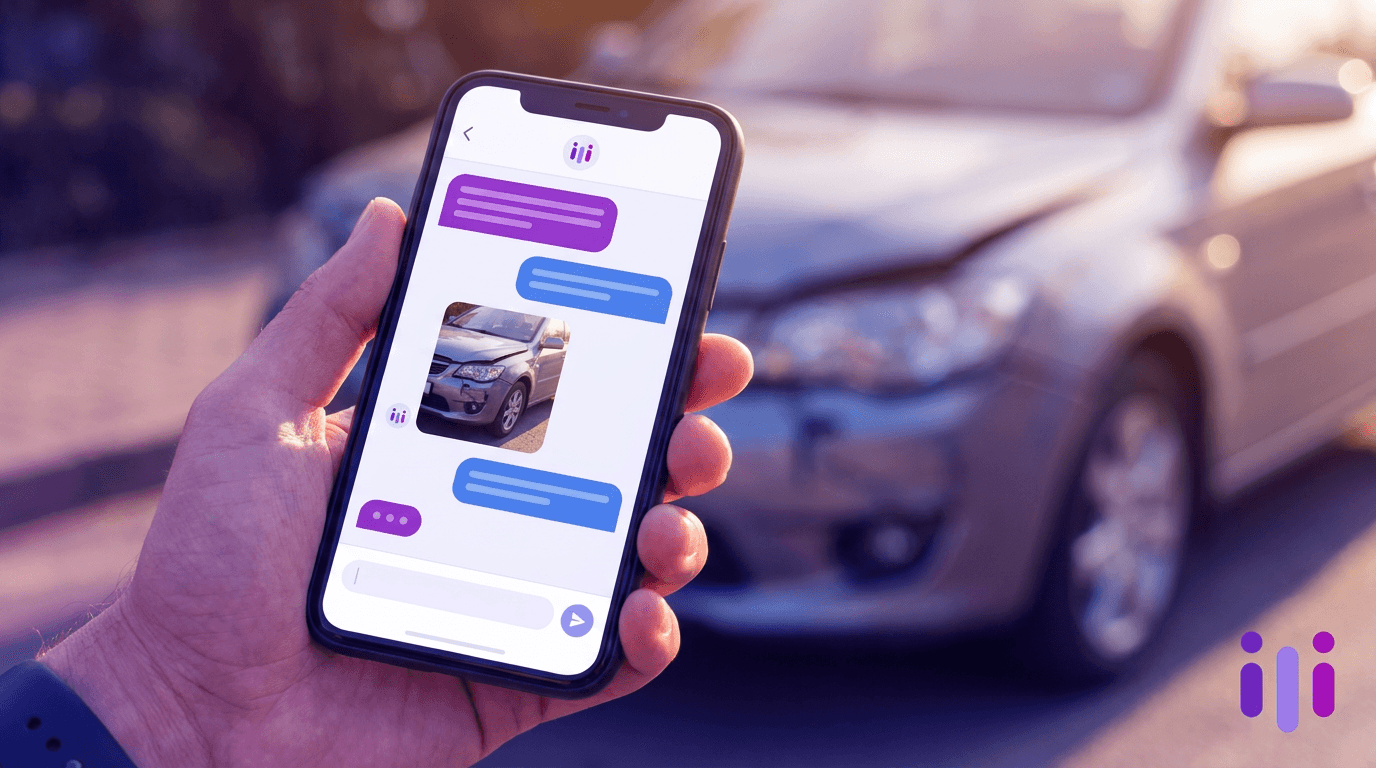
QuickFoto Claim is Allstate's photo-based damage estimation product, launched inside the Allstate Mobile app in 2014. Customers with driveable vehicles photograph the damage, upload it through the app, and receive an estimate and an adjuster phone call within 24 hours. The feature is the most-cited insurance AI case study of the past decade, and the operational results explain why.
By 2017, Allstate publicly reported that QuickFoto handled roughly half of all driveable-vehicle claims — a share large enough to justify shutting drive-in claim centers and downsizing more than 500 field adjuster roles. Two new "digital operating centers" were opened to absorb the photo-estimation volume centrally. The estimating cycle, which had run five to seven days under the appraisal-appointment model, dropped to under 24 hours. Customer satisfaction held: nine out of ten QuickFoto users said they'd choose the app again over an in-person adjuster appointment, per Body Shop Business reporting.
The strategic move embedded inside QuickFoto is worth naming. Allstate did not replace the adjuster's judgment with AI in 2014 — it replaced the adjuster's physical presence with a guided self-service capture flow plus centralized image review. The AI got smarter over time (computer vision now estimates parts and labor cost from the photo itself), but the structural win was design, not models. Most insurers studying QuickFoto get this backward.
Arity: The Telematics Substrate Underneath the Claims Decisions
Arity is Allstate's telematics and mobility data subsidiary, spun out as its own company in 2016 and now operating as both a data analytics firm and an insurance scoring engine. Arity's flagship asset is its driving behavior dataset, which the company says crossed the one-trillion-mile mark in 2024. That data feeds three claims-adjacent capabilities:
Arity has not been without controversy in the current cycle. In January 2025, the Texas Attorney General sued Allstate and Arity for allegedly collecting and selling driving data from over 45 million Americans without adequate consent, primarily through SDKs embedded in third-party mobile apps such as Life360. Class action filings followed. Arity has since announced direct-to-consumer transparency tools that let drivers see whether a driving report exists on them. The litigation is a useful reminder that a powerful data substrate is also a regulatory liability surface — carriers building their own telematics layer should plan the consent architecture before they plan the model architecture.
For our purposes here, the relevant fact is that Arity is the connective tissue between policy underwriting, FNOL detection, and downstream claims AI. Without it, QuickFoto is a faster damage estimate. With it, the entire claim arc — from "we noticed a hard braking event" through "your repair is scheduled" — can be triggered and resolved with substantially less human queueing.
The 2024–2025 Layer: Generative AI for Claims Communications
The newest layer in Allstate's stack is a generative AI system that drafts written communications to claimants. The disclosure came in early 2025 from Allstate CIO Zulfi Jeevanjee in a Fortune interview, and the numbers are unusually concrete:
- 23,000 reps writing claims correspondence
- ~50,000 communications per day to claimants
- "Almost all" of those communications now drafted by AI (specifically OpenAI GPT models grounded in Allstate's internal language)
- Adjusters review and personalize rather than draft from a blank template
Two operational outcomes stand out. First, the AI-drafted messages are reportedly less accusatory and lower in insurance jargon — adjusters trained on policy language tend to default to phrases customers don't speak. Second, internal time per communication drops materially because the workflow shifts from drafting to verification, per The Register's reporting on the rollout.
This is, on paper, an empathy and throughput win. It is also a one-way channel. Generative AI drafting improves the quality of what Allstate sends. It does not improve the structure of what Allstate receives from claimants between FNOL and settlement.
The Gap: Conversational AI as the Receiving Side of the Claim
The receiving side of a claim — the 30-to-90-day window between FNOL and final settlement — is still a tangle of phone calls, IVR menus, status emails answered by support reps, and one-shot satisfaction surveys after the file closes. None of those modes capture context. None of them surface the "why" behind a satisfaction score. None of them adapt their next question based on the previous answer. Forms, surveys, and IVR scripts share the same blind spot we cover in the glasswing principle on customer feedback tools: they capture fields, not context.
Three concrete claims moments are visible to any carrier benchmarking Allstate, and conversational AI is structurally better-suited to each than the tools currently deployed:
1. FNOL intake interviews. When a claimant calls or files through an app, the carrier needs structured facts (who, what, where, when, severity) plus unstructured context (what happened, how the claimant is feeling, what they're worried about, prior interactions). IVR captures the first set badly. Live agents capture both, expensively. A conversational AI interview captures both and routes the claim with the unstructured context attached — the same logic explored in conversational intake AI as a practical guide to replacing forms and in the broader case for replacing forms with AI chat.
2. Claim status interviews. Mid-cycle status check-ins (week 2, week 4, post-repair) are the highest-leverage moments to catch a churn-risk claimant before they file with a regulator or shop carriers. Generative AI drafting the outbound email does not replace a two-way conversation that asks "how is the rental working out for you" and follows up on a vague answer. The pattern is closer to the modern voice-of-customer programs we describe in the complete guide to voice of customer programs in 2026 than to traditional CSAT surveys.
3. Post-settlement claimant satisfaction interviews. Most carriers send a one-question NPS or short-form survey after a claim closes. Response rates run 5–15%, the comments box rarely fills, and root-cause data is thin. An AI-conducted interview that adapts based on the claimant's first answer — drilling into the rental experience for one customer and the adjuster communication for another — produces qualitatively different feedback. The AI-vs-survey mechanics for this are detailed in why conversations win for real customer research and the case for moving beyond static surveys in 2026.
The pattern across all three moments is the same: Allstate has automated drafting (gen AI), automated estimation (QuickFoto), and automated detection (Arity), but the conversation with the human on the other side is still surveyed, IVR'd, or manually staffed.
Why Most Carriers Get the Conversational Layer Wrong
Most carriers treat conversational AI as a deflection tool — a chatbot that exists to keep claimants out of contact center queues. That framing is a strategic error we've covered in detail in why conversational AI for insurance deflection is the wrong goal. When the explicit metric is "calls deflected," every product decision points toward narrower scripts, faster handoffs, and shallower understanding — the opposite of what claims work actually requires.
The better framing, and one Allstate's own gen-AI rollout already implies, is that AI should deepen the conversation, not shorten it. The claims rep using gen AI to draft a message still reviews it, personalizes it, and sends a richer note than the form-letter alternative. A conversational AI interviewing a claimant should do the same: ask a real question, follow up on the answer, capture context the claimant volunteers, and hand the human adjuster a better-prepared file. The architecture and adoption pattern is similar to what we describe for AI customer communications in the insurance industry and the broader 2026 adoption roadmap for AI in insurer communications.
What Other Carriers Should Take From the Allstate Playbook
Three lessons translate directly to any insurer's 2026 AI plan, regardless of book size:
-
Structural redesign beats model swaps. QuickFoto's primary win was redesigning the claim intake flow to put the customer's phone in the loop — the AI got better later. Carriers chasing GPT-class models without changing the underlying intake structure are buying a faster typewriter.
-
Automating drafting is necessary but not sufficient. Allstate's 50,000 daily AI-drafted communications are an internal productivity win. Claimants experience the content of the communication, not the cost-per-draft. The next-order question is whether the carrier is also automating the receiving side — and most aren't.
-
The data substrate determines what AI can do. Arity gave Allstate a trillion-mile dataset before any of the downstream claims AI mattered. Carriers without an equivalent — driving telematics, claims linguistic data, claimant interview transcripts — will hit a ceiling fast. Conversational AI with your claimants is one of the few ways to build a proprietary linguistic dataset specific to your book.
For carriers who want to map the broader vendor landscape, our 2026 roundup of AI tools for insurance customer experience and the practical playbook for AI across insurance agencies walk through where conversational AI plugs into existing workflows. Carriers focused on the policy-side equivalent — coverage explanation, billing, endorsements — will recognize the same pattern in how AI technology is replacing IVR and FAQ pages for policy inquiries and what carriers, brokers, and agents should expect from AI assistants.
How Perspective AI Fits Into the Conversational Layer
Perspective AI runs the conversational layer Allstate's stack is missing. We conduct AI-moderated interviews — at FNOL, mid-claim, post-settlement — that follow up on vague answers, probe for root cause, and produce structured insights from unstructured claimant context. Forms and surveys flatten claimants into dropdowns; our interviewers let them speak in their own words. The pattern is the same one we've shown work for Lemonade's category-defining conversational claims experience, translated to incumbents who already have the operational AI in place.
For an Allstate-shaped carrier, the practical question is not "should we build conversational AI?" — Allstate's own data already shows that 50,000 AI-drafted messages a day will not, on their own, lift claimant NPS. The question is "what's the first claim moment where a real two-way conversation would change the outcome?" Most carriers find the answer is FNOL intake or post-settlement satisfaction interviews. Both are run-of-business surfaces today.
Frequently Asked Questions
What is Allstate's QuickFoto Claim?
QuickFoto Claim is Allstate's photo-based auto-claim damage estimation feature, launched inside the Allstate Mobile app in 2014. Customers with driveable vehicles take photos of the damage, upload them through the app, and receive an estimate plus an adjuster call within 24 hours. The feature now handles roughly half of all driveable-vehicle claims and helped Allstate close drive-in claim centers and reduce its field appraisal headcount.
How does Allstate use generative AI in claims?
Allstate uses generative AI to draft written communications sent by its 23,000 claims reps to claimants — roughly 50,000 messages per day. The system, grounded on OpenAI GPT models with Allstate-specific language, drafts the email; the adjuster reviews, personalizes, and sends. Allstate reports the AI-drafted messages contain less insurance jargon and feel less accusatory than the human-only baseline, freeing adjusters to spend more time on the substance of the claim.
What is Arity and how does it support Allstate's AI claims work?
Arity is Allstate's telematics and mobility data subsidiary, operating as a separate company since 2016. Arity has collected over one trillion miles of driving behavior data, primarily from smartphone SDKs embedded in third-party apps. That dataset feeds usage-based insurance pricing, crash detection that can trigger FNOL automatically, and liability assistance during claim investigation. Arity has faced regulatory action in 2025, including a Texas Attorney General lawsuit over data-collection practices.
Where is Allstate's AI claims strategy still incomplete?
Allstate's AI claims strategy is strongest on the operations side — photo estimation, telematics, draft generation, internal copilots — and weakest on the receiving side of claimant conversations. Mid-claim status check-ins, FNOL intake interviews, and post-settlement satisfaction interviews still rely on IVR menus, form fields, and one-question surveys that capture data but not context. Conversational AI interviews are the most direct way to close that gap.
Should other carriers copy Allstate's AI claims playbook?
Other carriers should study the architecture of Allstate's AI claims playbook rather than copy specific products. The transferable lessons are that structural intake redesign matters more than model choice, that automating drafting is necessary but insufficient, and that proprietary data substrates (telematics, interview transcripts, claim linguistic data) determine the AI ceiling. Smaller carriers without Arity-scale data can build a comparable substrate by running conversational AI interviews across their own claim moments.
Conclusion
Allstate's AI claims strategy is a useful benchmark precisely because it's been visible and measurable for over a decade. QuickFoto Claim proved that customers will accept self-service capture if the design is right, Arity proved that a data substrate is the precondition for downstream claims AI, and the 2024–2025 generative AI rollout proved that even at 50,000 daily messages, AI drafting alone does not close the experience gap with claimants. The remaining layer — two-way conversational AI at the receiving side of every claim — is where the next decade's competitive separation will sit.
If you're modeling out where conversational AI fits inside your own carrier's claims operation, Perspective AI's interview platform is built for the FNOL-to-settlement arc. Run a structured FNOL intake interview, a mid-claim status interview, or a post-settlement satisfaction interview, and see what Allstate-style operational AI is missing on its own.
More articles on Intelligent Intake
Geico's AI Chatbot Strategy: How the Auto Insurance Giant Is Replacing Forms with Conversations in 2026
Intelligent Intake · 11 min read

Hippo Insurance's AI Home Strategy: IoT, Smart Home Data, and the Conversational Risk Interview
Intelligent Intake · 11 min read

Next Insurance and the AI-First SMB Insurance Playbook: How Conversational Quoting Beats Form-Based Quoting
Intelligent Intake · 16 min read

Progressive's Snapshot and the Conversational AI Frontier: How Telematics Pioneers Are Replacing Survey Calls
Intelligent Intake · 12 min read
Root Insurance's AI Underwriting Bet: Behavior-Based Pricing and the Conversational Risk Interview
Intelligent Intake · 15 min read

State Farm's AI Roadmap: How the Largest US Insurer Is Modernizing Customer Experience in 2026
Intelligent Intake · 13 min read