Geico's AI Chatbot Strategy: How the Auto Insurance Giant Is Replacing Forms with Conversations in 2026
TL;DR
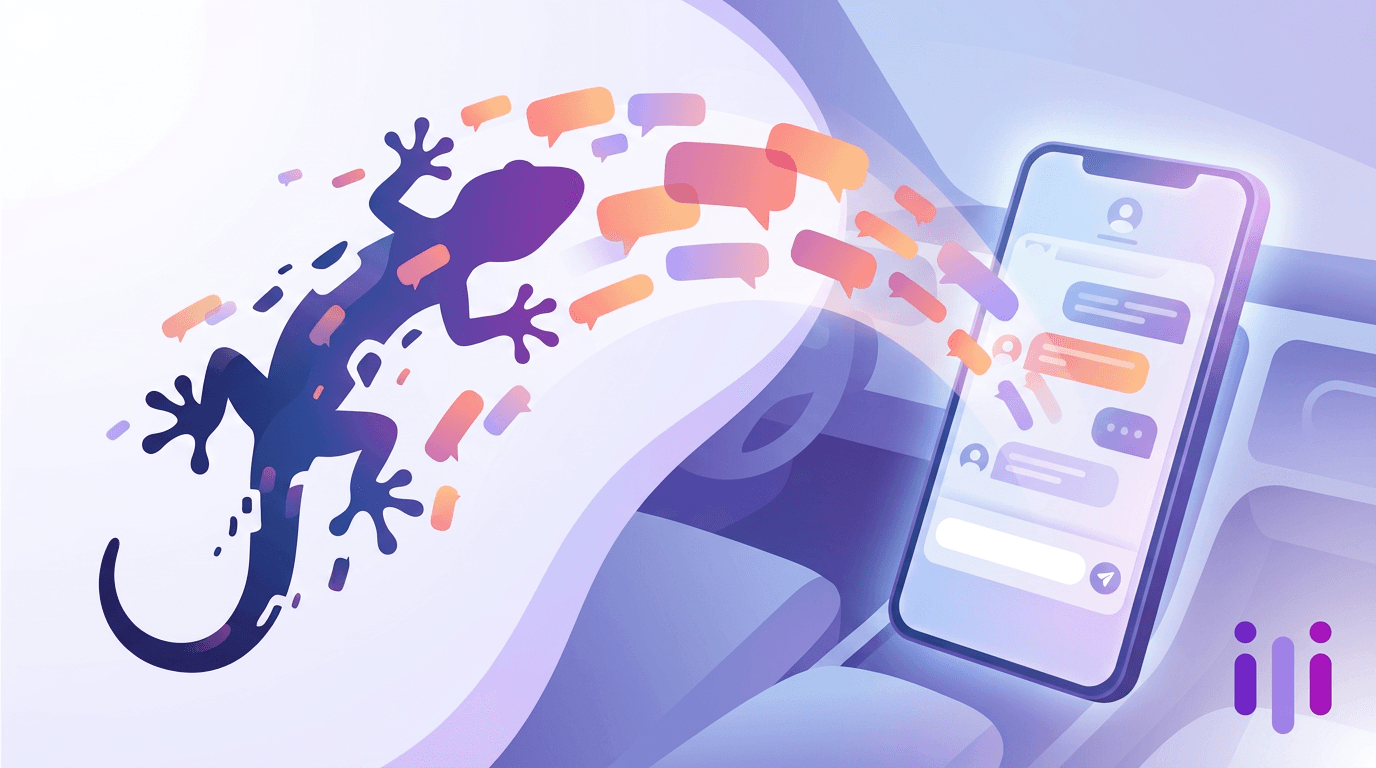
Geico's AI chatbot strategy in 2026 centers on Kate, a virtual assistant inside the Geico Mobile app that answers policy, billing, and document questions through natural-language conversation instead of forms. Kate launched in January 2017 on iOS, expanded to Android the same year, and is credited with a 10% lift in mobile app engagement after rollout. Geico has since opened a Palo Alto AI office, hired Vijay Raghavendra as Chief Technology and Product Officer, and adopted Tractable's computer-vision AI for auto claims damage triage. J.D. Power's 2025 data shows 47% of auto insurance shoppers now buy digitally and digital-first claims journeys score highest in satisfaction, but only 22% of insurers deliver adequate digital status updates — the gap Geico's conversational layer is built to close. Carriers without Geico's engineering scale can replicate the model using AI interview platforms like Perspective AI rather than building Kate-class assistants from scratch.
What Geico's AI Chatbot Actually Does in 2026
Geico's AI chatbot is a customer-facing virtual assistant called Kate that lives inside the Geico Mobile app and answers policy, billing, and document questions through text or voice. Kate is a speech-recognition front-end paired with a neural-network reasoning layer; she pulls policyholder data on demand so a driver can ask "when is my next payment due" and get a direct answer instead of tapping through five menus. The chatbot is also reachable through a separate "GEICO AI Virtual Assistant" experience on geico.com that handles general insurance questions for non-policyholders.
That distinction matters. Kate is a logged-in, account-aware assistant. The web-facing AI Virtual Assistant is anonymous and informational. Both are part of the same strategic bet: replace static FAQ pages, IVR trees, and contact forms with a conversation that knows what to ask next. We unpack why that bet pays off across the industry in our practical guide to AI-enabled customer engagement for CX and product teams in 2026.
A Short History: From the Gecko to a Generative-AI Carrier
Geico's AI program did not start in 2024 — it started in January 2017 when the company introduced Kate alongside a redesigned mobile app. According to Geico's 2017 launch announcement on Business Wire, Kate was positioned to "intuitively answer insurance questions" using natural-language understanding. PYMNTS reported a 10% increase in mobile app engagement attributable to Kate.
What's changed in 2026 is the scope. Geico has invested in a Palo Alto AI office, hired CTO Vijay Raghavendra (who has said Geico is "fundamentally reshaping how insurance is delivered in an AI-enabled world"), partnered with Tractable for computer-vision claims assessment trained on millions of historical claim images, and adopted a hybrid on-prem-plus-cloud infrastructure that AMD's 2024 case study attributes to faster retrieval, lower egress cost, and tighter data residency.
For a deeper look at where the broader industry is moving, see our 2026 state-of-the-industry report on AI customer communications in insurance.
Where Kate Works: Self-Service That Actually Self-Serves
Kate works best for high-frequency, low-stakes account questions where the answer is already in Geico's data: balance, payment date, ID card retrieval, coverage summary, document download, roadside service request. These are the questions that historically clogged contact centers and pushed hold times into the double digits.
Three reasons it works:
- Account-aware context. Kate knows who you are, what policy you have, and what state you're in. She doesn't need a 12-field intake form to triage your request — the form already happened during onboarding.
- Conversational repair. If you ask something ambiguous ("can I drive my brother's car?"), Kate can ask a clarifying follow-up rather than dump a generic FAQ page on you. We dig into the same dynamic for product research in our breakdown of why AI conversations beat surveys for real customer research.
- Mobile-native surface. Kate isn't bolted onto a desktop site. She's inside the app the policyholder already has installed, so the cost of starting a conversation is one tap.
The pattern generalizes — any carrier that nails account-aware self-service inside a mobile app reclaims contact-center volume and improves NPS. Our 2026 roundup of AI tools for customer experience in insurance support, organized by workflow, covers the vendor landscape.
Where Kate Falls Short: The FNOL Problem
Where Geico's chatbot strategy still struggles is at First Notice of Loss (FNOL) — the moment a customer reports an accident. FNOL is the highest-emotion, highest-stakes, lowest-form-completion-rate moment in the entire customer lifecycle, and it's where chatbots historically deliver the worst experience.
The mismatch is structural. A standard FNOL flow is essentially a long form: date, location, description of damage, other party's information, photos, injuries, witnesses, police report number. When Kate (or any chatbot) tries to walk a stressed driver through that schema sequentially, the experience reverts to a wizard. The conversation becomes a form in disguise — every problem we cover in our post on why static intake forms kill conversion rate shows up again, just with chat bubbles around the dropdowns.
J.D. Power's 2025 U.S. Claims Digital Experience Study makes the gap visible: digital-only claims journeys score highest on customer satisfaction, but insurers deliver adequate digital status updates only 22% of the time, and only 36% of auto customers ever get status updates via the mobile app at all. Drivers want digital — they're just not getting digital that works.
The fix is not "more chatbot." The fix is conversational FNOL that follows up like a human adjuster would: open-ended description first, AI-driven follow-ups to fill the schema underneath, photo capture and OCR for the documentary fields, and a real human handoff the moment sentiment turns. That's the architecture we describe in our analysis of why "deflection" is the wrong goal for conversational AI in insurance.
What Other Carriers Can Learn From Geico
Carriers without Geico's engineering payroll can still copy the playbook — they just have to skip the parts that require a 200-person ML team. Five takeaways translate directly:
- Lead with the highest-frequency, lowest-stakes use case. Kate's wedge was billing and ID cards, not claims.
- Make the bot account-aware. Anonymous chatbots that don't know who you are reproduce the form problem.
- Treat FNOL as a separate product from billing chat. They have different emotional contexts and escalation patterns.
- Measure conversation quality, not deflection. Counting "tickets avoided" rewards the bot for being unhelpful — see our writeup on why deflection is the wrong goal for the metric problem.
- Buy the conversational layer, build the differentiator. Geico can afford to build Kate; most regional carriers cannot. Concentrate engineering on underwriting, pricing, and claims triage where data is the moat.
For vendor options, see our 2026 buyer's roundup of best AI tools for insurance brokers, organized by workflow and our comparison guide on AI for insurance agencies from lead capture through renewals.
How Conversational Intake Compares to Geico's Form-Plus-Bot Stack
The table below contrasts Geico's stack — built over a decade — with what a non-Geico carrier can stand up in weeks using a conversational AI interview platform.
Geico's stack isn't wrong — it's that the conversational layer has become a commodity. We cover that pattern in our definitional piece on what AI-native customer engagement actually means and why most vendors get it wrong.
Why the Lemonade Comparison Matters
Lemonade and Geico represent the two endpoints of the AI-insurance spectrum. Lemonade was AI-native from day one — its app onboards through Maya, a conversational bot, and pays many claims through Jim with no human in the loop for low-complexity events. Geico is the opposite: a 90-year-old carrier retrofitting AI onto an existing operations stack. We unpack the Lemonade side in our Lemonade case study on conversational AI in insurance. The takeaway from holding the two side-by-side: AI-native carriers win on intake speed and unit economics; legacy carriers win on coverage depth and pricing sophistication; the conversational layer is the equalizer either side can adopt.
Where Perspective AI Fits in the Carrier Stack
Geico can afford to build Kate. Most carriers cannot. Perspective AI provides the conversational interview layer carriers need to replace forms with conversations across quote, FNOL, renewal, win/loss, and post-claim NPS — without spinning up a Palo Alto AI office. We talk to carriers like a human research partner would: open-ended question first, AI follow-up for context, structured data extracted underneath, no static form ever shown to the customer.
For a closer look at the architecture, see our analysis of AI technology for insurance policy inquiries and how carriers are replacing IVR and FAQ pages in 2026, and our breakdown of AI customer engagement software with categories and a buyer's framework.
Frequently Asked Questions
What is Geico's AI chatbot called?
Geico's AI chatbot is named Kate, and she lives inside the Geico Mobile app. Kate is a natural-language virtual assistant that answers policy and billing questions, surfaces ID cards, schedules payments, and helps with document retrieval. There is also a separate "GEICO AI Virtual Assistant" on geico.com for non-policyholder questions, but Kate is the account-aware experience policyholders interact with.
When did Geico launch its AI chatbot?
Geico launched Kate in January 2017, initially on iOS and shortly after on Android. The launch was announced through Business Wire and covered by Marketing Dive, PYMNTS, and The Digital Insurer. Geico has continuously expanded Kate's capabilities since then and added a separate web-facing AI Virtual Assistant in subsequent releases.
How effective is the Geico AI chatbot?
Public reporting credits Kate with a 10% increase in mobile-app engagement after launch, and Geico has cited her as a contributor to lower hold times at the contact center. J.D. Power's 2025 studies show that mobile-app-based digital service is the highest-satisfaction channel for auto insurance, but only 36% of customers receive status updates that way — meaning even Geico's investment leaves real gap-closing room across the industry.
Can Geico's chatbot file a claim?
Geico's chatbot can start a claim and route the customer into the FNOL flow inside the app, but the actual claim filing is still primarily a structured wizard rather than a free-form conversation. Damage assessment is then handled by Tractable's computer-vision AI, which evaluates photos against millions of historical claim images. The conversational portion of FNOL is the area where most carriers — including Geico — still have the largest customer-experience gap.
Is Geico's chatbot strategy worth copying for smaller carriers?
The strategy is worth copying — the engineering approach is not. Smaller carriers should adopt Geico's principle of replacing forms and IVR with conversations, but they should buy the conversational layer rather than build it. A 200-person ML team in Palo Alto is not the only path to a Kate-class experience; vendor platforms now make the same UX achievable in weeks rather than years. Carriers should focus internal engineering on pricing, underwriting, and claims-triage models where their proprietary data creates a real moat.
Conclusion
Geico's AI chatbot strategy in 2026 is a blueprint and a caution at the same time. The blueprint: lead with high-frequency self-service in the mobile app, make the bot account-aware, invest in conversational repair, and pair it with a vision system for claims triage. The caution: building Kate took a decade, a Palo Alto office, and a top-tier CTO hire — and the chatbot still fights the same FNOL form problem every other carrier faces. Carriers that want a Geico-class AI assistant without the build cost should adopt a conversational interview layer that handles intake, FNOL, and post-claim research in natural language by default.
Perspective AI is built for that layer. We help carriers replace static intake forms with AI-led interviews that follow up, probe, and extract structured data underneath — across quote, FNOL, renewal, and voice-of-customer programs. If your team is staring at a Kate-shaped roadmap and a regional-carrier engineering budget, start a conversation with Perspective AI and see what an AI interview layer looks like in your stack.
More articles on Intelligent Intake
Allstate's AI Claims Strategy: What QuickFoto Claim and Conversational AI Mean for the Industry
Intelligent Intake · 13 min read
Hippo Insurance's AI Home Strategy: IoT, Smart Home Data, and the Conversational Risk Interview
Intelligent Intake · 11 min read

Next Insurance and the AI-First SMB Insurance Playbook: How Conversational Quoting Beats Form-Based Quoting
Intelligent Intake · 16 min read

Progressive's Snapshot and the Conversational AI Frontier: How Telematics Pioneers Are Replacing Survey Calls
Intelligent Intake · 12 min read
Root Insurance's AI Underwriting Bet: Behavior-Based Pricing and the Conversational Risk Interview
Intelligent Intake · 15 min read

State Farm's AI Roadmap: How the Largest US Insurer Is Modernizing Customer Experience in 2026
Intelligent Intake · 13 min read