Advocate
Updated: March 30, 2026
The Advocate agent flips outreach on its head. Instead of blasting the same pitch at everyone and hoping it sticks, it listens first — understanding each person's situation, concerns, and priorities — then delivers your message tailored specifically to them, handling objections with relevant proof points from your playbook.
When to Use an Advocate Agent
Advocate agents excel when you need:
-
Personalized persuasion — You have a message, position, or case to make, and one-size-fits-all doesn't work
-
Objection handling — People have concerns, and you have specific answers — but only if you know which concerns to address
-
Two-way engagement — You want people to feel heard, not pitched at
-
Scalable advocacy — You need to make your case to hundreds or thousands of people individually
-
Tailored delivery — The same core message needs to land differently depending on who's hearing it
Ideal use cases:
- Product advocacy and adoption campaigns
- Sales objection handling at scale
- Policy representation and stakeholder communication
- Brand advocacy and repositioning
- Cause-driven outreach and mobilization
- Internal change management and initiative rollouts
- Partner enablement and channel education
How Advocate Agents Work
Advocate agents use a two-phase conversational approach:
Phase 1: Discovery
The agent opens by listening. It asks questions to understand:
Situation — What is this person's context? What are they dealing with?
Concerns — What worries them? What has gone wrong before? What are their objections?
Priorities — What matters most to them? What would success look like?
Knowledge level — How much do they already know? What misconceptions exist?
This phase feels like a genuine conversation, not a setup for a pitch. The agent demonstrates understanding through thoughtful follow-ups, building trust before delivering any message.
Phase 2: Tailored Advocacy
Based on what it learned in discovery, the agent selects the most relevant arguments, proof points, and framing from your playbook. It:
Matches messaging to concerns — Addresses what this specific person cares about, not a generic list of benefits
Handles objections with evidence — Uses specific proof points, case studies, or data that directly answer their hesitations
Adapts tone and framing — Technical audiences get technical depth; executives get strategic framing; skeptics get acknowledgment before evidence
Stays on message — Advocates for your position consistently while adapting delivery to each individual
Knows its limits — If a question falls outside the playbook, it acknowledges honestly rather than fabricating
Before You Begin
Define Your Position
What are you advocating for? Be specific:
- What is the core message or position?
- What are the key arguments supporting it?
- What proof points, case studies, or data back each argument?
- What is the desired outcome of each conversation?
Map Common Objections
What pushback do you expect? For each objection:
- What is the concern?
- What is your best response?
- What evidence supports that response?
- Are there situations where the objection is valid? How should the agent handle that honestly?
Identify Your Audience
Who are you trying to reach, and how do they differ?
- What segments exist within your audience?
- What does each segment care about most?
- What objections are most common per segment?
- What language and framing resonates with each?
Prepare Your Playbook
The playbook is the foundation of your Advocate agent. It contains:
- Your core position and key messages
- Arguments organized by theme or audience concern
- Proof points, data, case studies, and examples
- Objection-response pairs
- Tone and boundary guidelines
Creating Your Advocate Agent
Step 1: Select the Advocate type
- Navigate to agent creation in Perspective AI
- From the agent type options, select Advocate
You'll see example prompts to help you get started, such as:
- "Advocate for our new product to skeptical prospects"
- "Represent our policy position to stakeholders"
- "Help customers understand why we made this change"
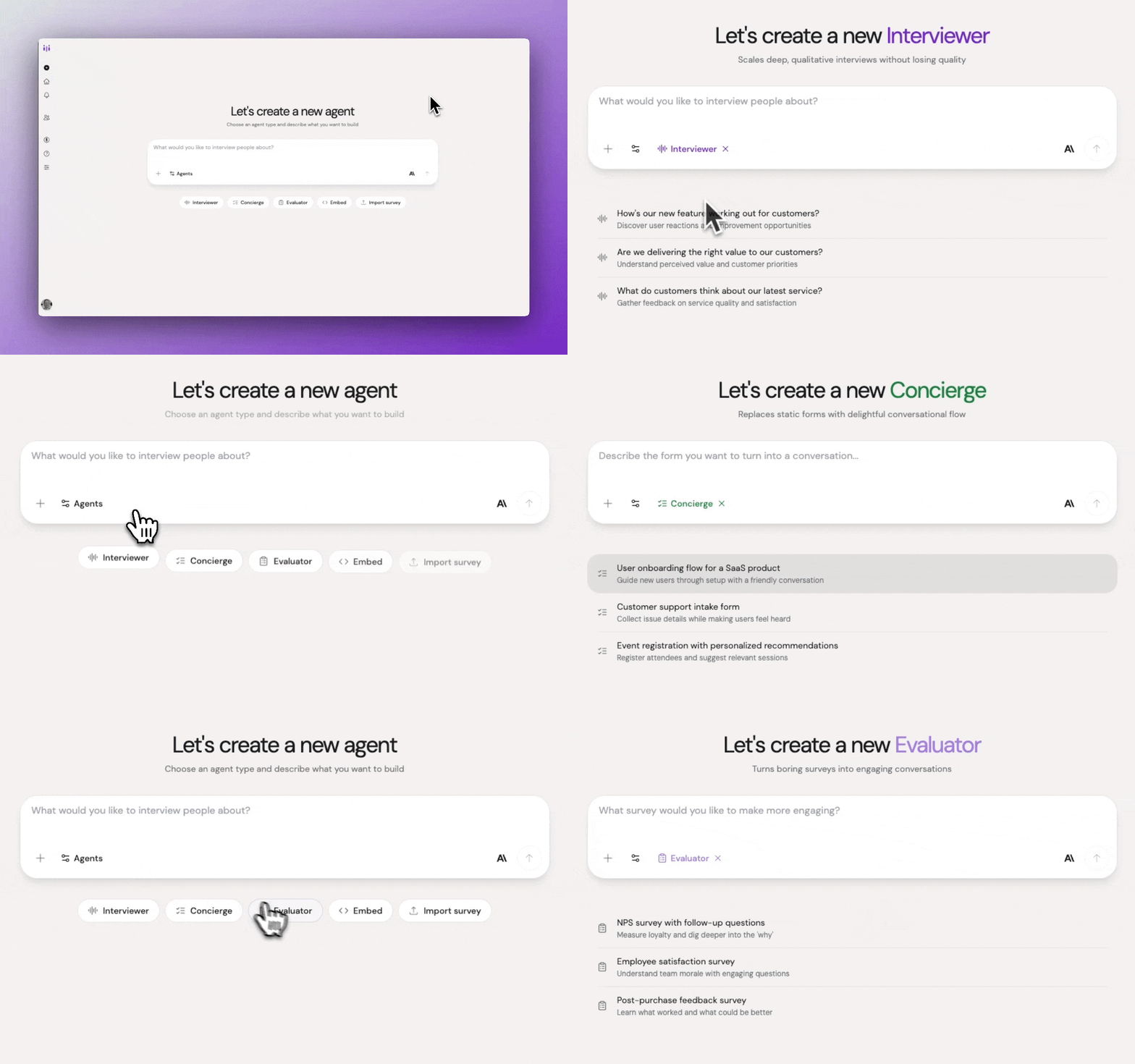
Agent type selection showing Advocate highlighted
Step 2: Describe your advocacy goal
Explain what you are advocating for and who you are trying to reach. Perspective will ask you about:
- Your position — What message or case are you making?
- Target audience — Who are you trying to persuade or educate?
- Key arguments — What are your strongest points?
- Common objections — What pushback do you anticipate?
- Desired outcome — What does success look like?
Example:
"I want to advocate for our new enterprise pricing model to existing customers. Many are concerned about price increases, but the new model actually saves most teams money because of usage-based billing. I need to understand each customer's situation first, then show them how the change specifically benefits them using real cost comparisons."
Step 3: Answer clarifying questions
Perspective will assess whether it has enough information to create your outline. If it needs more context about your position, proof points, objection handling, or audience, it will ask targeted follow-up questions to ensure the agent can advocate effectively.
Step 4: Review the generated outline
Once Perspective has sufficient context, it will generate an outline optimized for advocacy. The outline includes:
Advocacy objective: What you are advocating for and what outcome you want
Discovery questions: What the agent should learn about each person before advocating
Playbook: Key arguments, proof points, and evidence organized by theme
Objection handling: Anticipated objections paired with specific responses
Interview guidelines: Instructions for tone, boundaries, and the balance between listening and advocating
Methodology: Confirmation of the two-phase discovery-then-advocacy approach
Step 5: Refine your agent
Adjust the outline conversationally to match your needs:
Example refinements:
- "Spend more time in discovery before presenting any arguments"
- "If someone mentions a competitor, use the comparison data from our sales deck"
- "Keep the tone consultative, not salesy — we're helping them make a decision, not closing a deal"
- "If someone has a concern we can't address, acknowledge it honestly and offer to connect them with a specialist"
- "Add a proof point about the 40% cost reduction that Company X achieved"
Each refinement updates your outline while maintaining the two-phase approach.
Step 6: Test the conversation
Experience it as a participant would:
- Click Try it out from the design view
- Play different roles — a skeptic, someone already interested, someone with specific objections
- Evaluate:
- Does the discovery phase feel genuine, not like a setup for a pitch?
- Does the agent listen before advocating?
- Are proof points relevant to what you shared?
- Does objection handling feel informed, not defensive?
- Is the tone appropriate — persuasive without being pushy?
- Does it stay on message without sounding scripted?
Step 7: Iterate based on testing
Test with different personas and objection patterns. The agent should adapt its advocacy naturally based on what each person shares in discovery. Make adjustments, then test again.
Step 8: Invite participants
Once satisfied, invite participants using your preferred method.
Interview Guidelines for Advocate Agents
Guidelines shape how the agent balances listening with advocating.
Default Approach
Advocate agents naturally:
- Open with genuine curiosity about the participant's situation
- Listen actively and demonstrate understanding before making any case
- Select arguments relevant to what the participant shared
- Handle objections with specific evidence, not generic reassurance
- Maintain a consultative tone throughout
- Acknowledge valid concerns honestly
- Stay within the boundaries of the playbook
- Adapt depth and framing based on the participant's knowledge level
Customizing Guidelines
Adjust guidelines to match your advocacy context:
For skeptical audiences:
"Spend extra time in discovery. Acknowledge their skepticism directly and validate that it's reasonable. Lead with evidence and third-party validation rather than claims. Let them arrive at conclusions rather than pushing them."
For technical audiences:
"Match their technical depth. Use precise language and specific data points. Skip high-level marketing framing and go straight to how it works, what the tradeoffs are, and what the evidence shows."
For executive audiences:
"Focus on strategic impact and outcomes, not features or implementation details. Frame everything in terms of business results, risk reduction, and competitive advantage. Be concise — respect their time."
For change-resistant audiences:
"Acknowledge that change is hard and that their current approach has worked for them. Frame your advocacy as evolution, not disruption. Lead with what stays the same before introducing what changes."
Best Practices for Advocate Agents
Invest in your playbook. The quality of advocacy depends entirely on the quality of your proof points, arguments, and objection responses. Vague claims produce vague advocacy.
Listen before you advocate. The discovery phase is not a formality. The more the agent understands, the more precisely it can tailor the message. Don't rush it.
Be honest about limitations. If your position has genuine weaknesses, acknowledge them. Credibility lost to dishonesty cannot be recovered.
Map objections thoroughly. Every unhandled objection is a conversation that ends in "I'll think about it." Prepare responses for every concern you have heard in real conversations.
Use real proof points. Specific numbers, named case studies, and concrete examples persuade. Abstract benefits do not.
Test with your toughest audience. If the agent handles a committed skeptic well, it will handle everyone else.
Review early conversations. The first 5-10 transcripts reveal whether discovery is deep enough and whether advocacy lands. Adjust before scaling.
Set clear boundaries. Define what the agent should and should not claim. Define when it should escalate to a human.
Common Pitfalls & Fixes
Skipping discovery — If the agent jumps to advocacy too quickly, participants feel pitched at. Ensure the outline emphasizes discovery first and provides enough discovery questions.
Weak proof points — Generic claims like "our customers love it" don't persuade. Replace with specifics: "Company X reduced costs by 40% in the first quarter."
Defensive objection handling — If the agent argues against objections rather than addressing them, it feels adversarial. Reframe guidelines to acknowledge first, then provide evidence.
Too salesy — If participants disengage, the tone is likely too aggressive. Shift guidelines toward consultative language and let evidence do the persuading.
One-size-fits-all messaging — If the agent delivers the same pitch regardless of what people share in discovery, the discovery-advocacy connection is too weak. Review how arguments are mapped to concerns.
Overpromising — If the agent makes claims beyond the playbook, tighten the boundaries. Advocates should be trusted messengers, not wild improvisers.
Not knowing when to stop — If someone is convinced, the agent should recognize that and wrap up. Continued advocacy after agreement is counterproductive. Include guidelines for recognizing buying signals.
Ignoring valid objections — Some objections are legitimate. If the agent dismisses them, it destroys trust. Include honest responses for concerns you cannot fully address.
Example Advocate Agents
Example 1: Product Pricing Change
Advocacy goal:
"Help existing customers understand our new usage-based pricing model and show them how it benefits their specific situation."
Discovery focus:
- Current plan and usage patterns
- Concerns about the change
- What they value most about the product
Playbook highlights:
- 73% of customers pay less under the new model
- Usage-based pricing means they only pay for what they use
- Comparison calculator showing old vs. new cost
- Migration timeline and support available
Objection handling:
- "My bill will go up" — Show personalized comparison; offer grandfathered rate for 6 months if true
- "I prefer predictable billing" — Explain spending caps and alerts available in new model
- "Why are you changing this?" — Explain alignment with customer feedback requesting flexibility
Example 2: Internal Change Management
Advocacy goal:
"Build support for the company-wide migration from Slack to Microsoft Teams among department leads."
Discovery focus:
- How their team currently uses Slack
- Integrations and workflows that depend on Slack
- Past experience with tool migrations
Playbook highlights:
- Security compliance requirements driving the change
- Integration with existing Microsoft 365 suite
- Migration support and training timeline
- Three departments that already migrated successfully
Objection handling:
- "Slack works fine for us" — Acknowledge that, then explain the security compliance driver
- "We'll lose our integrations" — Walk through integration compatibility and alternatives
- "Our team hates change" — Share feedback from teams that already migrated; offer phased approach
Example 3: Policy Advocacy
Advocacy goal:
"Represent our sustainability initiative to supply chain partners and build commitment to new environmental standards."
Discovery focus:
- Their current sustainability practices
- Business pressures and constraints they face
- Their customers' expectations around sustainability
Playbook highlights:
- Regulatory requirements taking effect next year
- Consumer demand data showing 68% preference for sustainable supply chains
- Cost reduction case studies from early adopters
- Support program covering certification costs for partners
Objection handling:
- "We can't afford this" — Present the cost support program and ROI data from similar companies
- "Our customers don't care" — Share consumer survey data and retailer requirements
- "The timeline is too aggressive" — Offer phased adoption with milestone support
Analyzing Advocate Results
Conversation Outcomes
Review conversations to understand:
- Persuasion effectiveness — How many participants shifted their position or expressed interest?
- Common objections — Which concerns came up most? Were responses effective?
- Discovery quality — Did the agent learn enough to tailor advocacy meaningfully?
- Drop-off points — Where did participants disengage, if they did?
Improving Your Playbook
Use conversation data to:
- Add proof points for objections that came up unexpectedly
- Strengthen responses to frequently raised concerns
- Remove arguments that did not resonate with anyone
- Identify new audience segments with distinct concern patterns
- Refine discovery questions based on what proved most useful
Measuring Impact
Track:
- Engagement rate — How many participants completed the full conversation?
- Sentiment shift — Did participants' tone change from skeptical to interested?
- Action taken — Did participants follow through on the desired outcome?
- Objections resolved — Which concerns were addressed effectively vs. left unresolved?
What Makes Advocate Agents Different
Unlike Interviewer agents (which explore open-ended territories to discover insights), Concierge agents (which efficiently collect structured information), or Evaluator agents (which systematically measure defined criteria), Advocate agents are designed to persuade. They combine genuine listening with strategic messaging — understanding each person first, then making your case in the way most likely to resonate with them specifically.
When to Use Advocate Agents
Use Advocate agents when the conversation should listen first, then respond from a defined position or playbook.