What Is Customer Feedback? Types, Collection Methods, and How to Act on It
What is customer feedback?
Customer feedback is the information customers share about their experience with a product, service, or brand — what worked, what frustrated them, and what they wish were different. It spans everything from a one-tap star rating to an unprompted support email, and teams use it to measure satisfaction, prioritize improvements, and predict retention.
Feedback is the raw material of every customer experience program. A customer experience function without a steady feedback supply is flying blind — it can ship features, run campaigns, and staff a support desk, but it can't tell whether any of it landed. The hard part isn't collecting feedback; most companies drown in it. The hard part is capturing the reason behind each data point and turning it into a decision.
Types of customer feedback
Customer feedback sorts along two independent axes: how you got it (solicited vs. unsolicited) and what form it takes (quantitative vs. qualitative). Crossing those two axes produces the four practical categories most teams work with.
Solicited vs. unsolicited feedback
Solicited feedback is feedback you actively request; unsolicited feedback is feedback customers volunteer without being asked. Solicited channels — surveys, interviews, feedback widgets, polls — give you control over timing, sample, and question, which makes them good for tracking a metric consistently. Unsolicited channels — support tickets, reviews, social mentions, cancellation notes — are noisier but often more honest, because the customer cared enough to speak up unprompted. A healthy program listens to both: solicited feedback tells you how the average customer feels, and unsolicited feedback tells you what the most motivated ones can't stop talking about.
Quantitative vs. qualitative feedback
Quantitative feedback is expressed as numbers you can aggregate; qualitative feedback is expressed as language you have to interpret. Quantitative signals — Net Promoter Score, CSAT, Customer Effort Score, and star ratings — are easy to chart and benchmark but tell you only what moved. Qualitative feedback — comments, interview transcripts, ticket text — carries the why, but it's harder to scale and quantify. The two are complementary, not competitive: the number is the alarm, and the words are the diagnosis. Most teams over-invest in the first and under-invest in the second, which is the single biggest reason feedback programs stall. For a full map of the numeric side, see the batch's overview of the customer experience metrics that matter.
Customer feedback collection methods
Customer feedback is collected through a mix of surveys, interviews, in-product prompts, support and review channels, and behavioral analytics — and the right mix depends on what decision the feedback needs to inform. No single method is complete on its own; each trades reach for depth or structure for spontaneity.
- Surveys and rating widgets — the workhorse for solicited quantitative feedback (NPS, CSAT, CES). Fast and cheap to run, but response rates are chronically low: transactional survey response rates commonly sit in the 5–15% range, and the open-comment box that carries the reasoning usually goes half-empty.
- Customer interviews — the deepest solicited method, and the only one that lets you follow up on a vague answer in the moment. Historically expensive and slow because they required a researcher on every call; AI-moderated interviews have removed that bottleneck.
- In-product prompts and micro-surveys — feedback captured at the moment of the experience, when memory is freshest.
- Support tickets and chat logs — a rich, continuous stream of unsolicited qualitative feedback that most teams treat as a cost center instead of a research asset.
- Reviews, ratings, and social listening — public, unsolicited signal that shapes how prospects perceive you before they ever talk to sales.
- Behavioral and product analytics — implicit feedback: what customers do, which sometimes contradicts what they say.
The Voice of the Customer program is the discipline of running these channels as one coordinated system rather than as disconnected one-off surveys, and choosing the right customer feedback software is largely about which channels a tool can unify and how deeply it can read the qualitative ones.
Turning customer feedback into action: the feedback loop
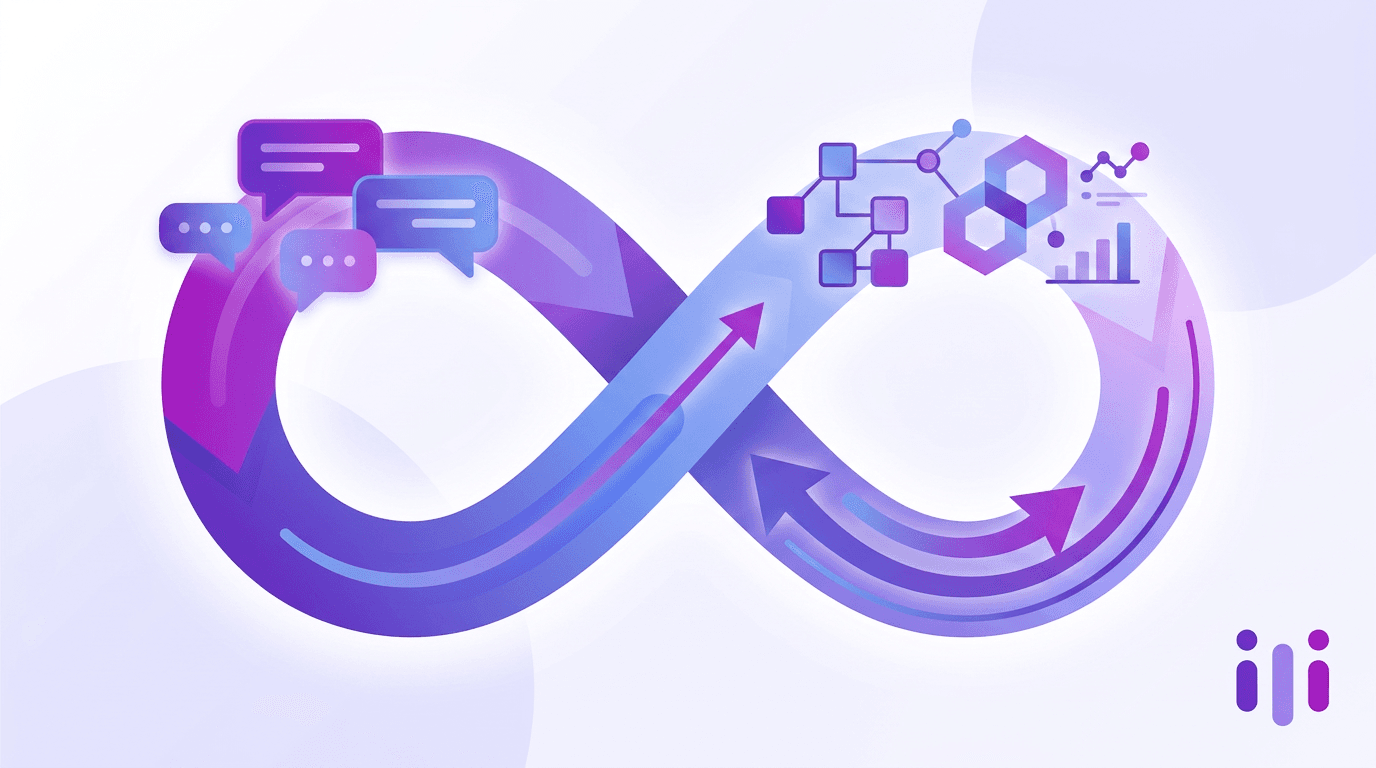
Customer feedback creates value only when it completes a loop: capture, analyze, act, and close back with the customer. Feedback that gets collected and filed — a "read-only" program — is worse than no program, because it trains customers that speaking up changes nothing. The loop has four stages:
- Capture — collect feedback across solicited and unsolicited channels, ideally at the moment of the experience rather than weeks later.
- Analyze — aggregate the quantitative signal to see what moved, then read the qualitative signal to understand why. This is where customer sentiment analysis and thematic coding turn thousands of comments into a short list of drivers. The operational mechanics of this stage are covered in depth in the customer feedback analysis playbook.
- Act — route the insight to the team that can fix it (product, CX, support) and actually change something.
- Close the loop — tell the customer what you did. Bain & Company's research on loyalty economics — the lineage behind NPS, first laid out in Fred Reichheld's 2003 Harvard Business Review article "The One Number You Need to Grow" — showed that following up with detractors is what converts a complaint into retained revenue.
Closing the loop is directly tied to retention: the customers who feel heard are the ones who stay, which is why feedback programs and customer retention strategy are two views of the same thing. Mapping where each stage of the loop lives across the customer lifecycle keeps it from collapsing into a once-a-year survey.
Why most customer feedback stays uncaptured
The largest source of customer feedback is the feedback you never receive, because the format you offered couldn't hold what the customer wanted to say. Research widely cited in customer-experience literature has long found that roughly 91% of dissatisfied customers who don't complain simply leave without a word — no survey answer, no review, no ticket. The silent majority churns, and the exit reason dies with them.
Two failures compound this. First, low response rates mean the numeric feedback you do get is skewed toward the extremes — the delighted and the furious — while the ambivalent middle, where most churn risk actually lives, stays quiet. Second, and more fundamental, forms and surveys flatten customers into schemas. A dropdown, a 0–10 scale, and a 200-character comment box force people to translate a messy, contextual experience into a shape the form can store. When the most valuable answer is "it depends" or "I'm not sure, but something felt off," the form has no cell for it, so the reason never gets recorded. That's why a dashboard full of scores can tell you what moved but never why — the explanatory data was discarded at the point of collection.
Conversational customer feedback: capturing the why
Conversational feedback replaces the static form with an interview: instead of a fixed list of questions, an AI interviewer asks an opening question, then follows up on the answer — probing vague statements, chasing the "why now," and letting the customer speak in their own words. This is the shift from survey-based measurement to conversational Voice of Customer that CX teams are making as they age out of legacy survey suites. The mechanics — and the evidence that conversations out-collect surveys for real research — sit at the center of the move beyond surveys toward automated conversations.
This is the approach Perspective AI is built on. Rather than emailing a survey and hoping for a 10% response, Perspective runs hundreds of AI-moderated interviews simultaneously, each one following up like a skilled researcher would, then analyzing the transcripts into themes and quotes automatically. The result is feedback that keeps its context: not just a CSAT of 3, but the sentence that explains why. Independent guidance from the Nielsen Norman Group on when to use qualitative vs. quantitative research methods makes the same underlying point — numbers tell you whether there's a problem; open-ended, conversational data tells you what it is and how to fix it.
Frequently Asked Questions
What are the main types of customer feedback?
The main types of customer feedback are solicited vs. unsolicited and quantitative vs. qualitative, which combine into four practical categories. Solicited feedback is requested (surveys, interviews); unsolicited feedback is volunteered (reviews, support tickets). Quantitative feedback is numeric (NPS, CSAT, star ratings); qualitative feedback is language-based (comments, transcripts). A strong program collects across all four rather than relying on a single metric.
What is the difference between solicited and unsolicited feedback?
Solicited feedback is information you actively ask customers for, while unsolicited feedback is information they volunteer on their own. Solicited channels — surveys, polls, feedback widgets, interviews — give you control over timing and questions, making them good for tracking a metric consistently. Unsolicited channels — support tickets, reviews, social posts — are noisier but often more candid, because the customer chose to speak up without prompting.
How do you collect customer feedback?
You collect customer feedback through surveys and rating widgets, customer interviews, in-product prompts, support and chat logs, public reviews, and behavioral analytics. The right mix depends on the decision you're informing: use surveys to trend a metric, interviews to understand the reasons behind it, and support and review data to catch issues you didn't think to ask about. Combining channels beats relying on any single one.
Why is customer feedback important?
Customer feedback is important because it is the only direct evidence of whether your product and service are meeting real needs, and it is a leading indicator of retention and growth. It tells you what to fix, which improvements to prioritize, and why customers stay or leave. Companies that close the loop — acting on feedback and telling customers what changed — retain more revenue than those that collect feedback and file it.
What should you do after collecting customer feedback?
After collecting customer feedback, run it through a four-stage loop: analyze the quantitative signal to see what moved, read the qualitative signal to understand why, route the insight to the team that can act, and close the loop by telling customers what you changed. Feedback that is collected but never acted on erodes trust, because it teaches customers that speaking up accomplishes nothing.
Conclusion
Customer feedback is easy to collect and hard to use. The four types — solicited, unsolicited, quantitative, and qualitative — and the channels that supply them are only worth the effort if they feed a loop that ends in a decision and a reply to the customer. The failure mode isn't too little feedback; it's feedback stripped of its reasoning at the point of collection, and a silent majority whose exit reason you never hear.
The fix is to stop flattening customers into forms. If you want feedback that arrives with the why already attached, start a conversational study with Perspective AI and let an AI interviewer ask the follow-up your survey never could — or see how CX teams run continuous feedback on conversations instead of static surveys.
Sources:
More articles on Customer Success & Churn Prevention
Customer Feedback in 2026: The Complete Guide to Collecting, Analyzing, and Acting On It
Customer Success & Churn Prevention · 12 min read
Pause vs Cancel in 2026: What Consumer Subscription Pause Requests Tell You
Customer Success & Churn Prevention · 24 min read
Customer Lifecycle Marketing: Matching the Message to the Phase
Customer Success & Churn Prevention · 17 min read
Customer Lifecycle Stages Explained: The Six Phases and What Each One Needs
Customer Success & Churn Prevention · 15 min read
Customer Lifecycle Touchpoints: Where to Listen and What to Ask at Each One
Customer Success & Churn Prevention · 19 min read
Customer Service Experience Examples: What Good Looks Like Across Five Channels
Customer Success & Churn Prevention · 19 min read