MetLife AI Strategy: How a 160-Year-Old Insurer is Modernizing Group Benefits with AI
TL;DR
MetLife's AI strategy in 2026 is not the flashiest in insurance — but it may be the most defensible. While AI-native startups like Lemonade dominate headlines in personal lines, MetLife is quietly rebuilding the unsexy core of its business: group benefits enrollment, disability claims triage, and the data plumbing that connects 160 years of underwriting history to modern models. This is a case study in incumbent AI strategy: where MetLife is moving fast, where it is conservatively (and probably correctly) behind, and what the rest of the century-old carrier cohort can learn.
What is MetLife doing with AI in 2026?
MetLife's 2026 AI strategy concentrates on its largest line — group benefits — with three pillars: conversational enrollment that replaces 40-page benefits PDFs, AI-assisted claims triage in disability and life, and an enterprise data layer that mines 160 years of underwriting and claims history. It is deliberately incremental, prioritizing high-volume employer touchpoints over consumer-direct disruption.
The strategy reflects MetLife's actual shape as a business. Roughly two-thirds of its U.S. revenue comes from group benefits sold through employers — life, dental, vision, disability, accident, and supplemental products. That is a fundamentally different distribution surface than the direct-to-consumer auto and home insurers that have dominated AI insurance coverage. MetLife does not need to convince an individual buyer in 90 seconds. It needs to make annual benefits enrollment feel less like filing taxes, and it needs to take operating cost out of a claims function that processes millions of disability and life events per year.
What you will not see from MetLife: a chatbot avatar named Maya doing TikTok-style claim approvals. What you will see: enrollment flows that quietly cut HR support tickets by double-digit percentages, and adjuster co-pilots that compress the median disability decision timeline. The carriers covered in our AI for insurance agents adoption data report follow a similar pattern — adoption is real, but it is internal-facing and operationally measured.
MetLife's group benefits enrollment migration
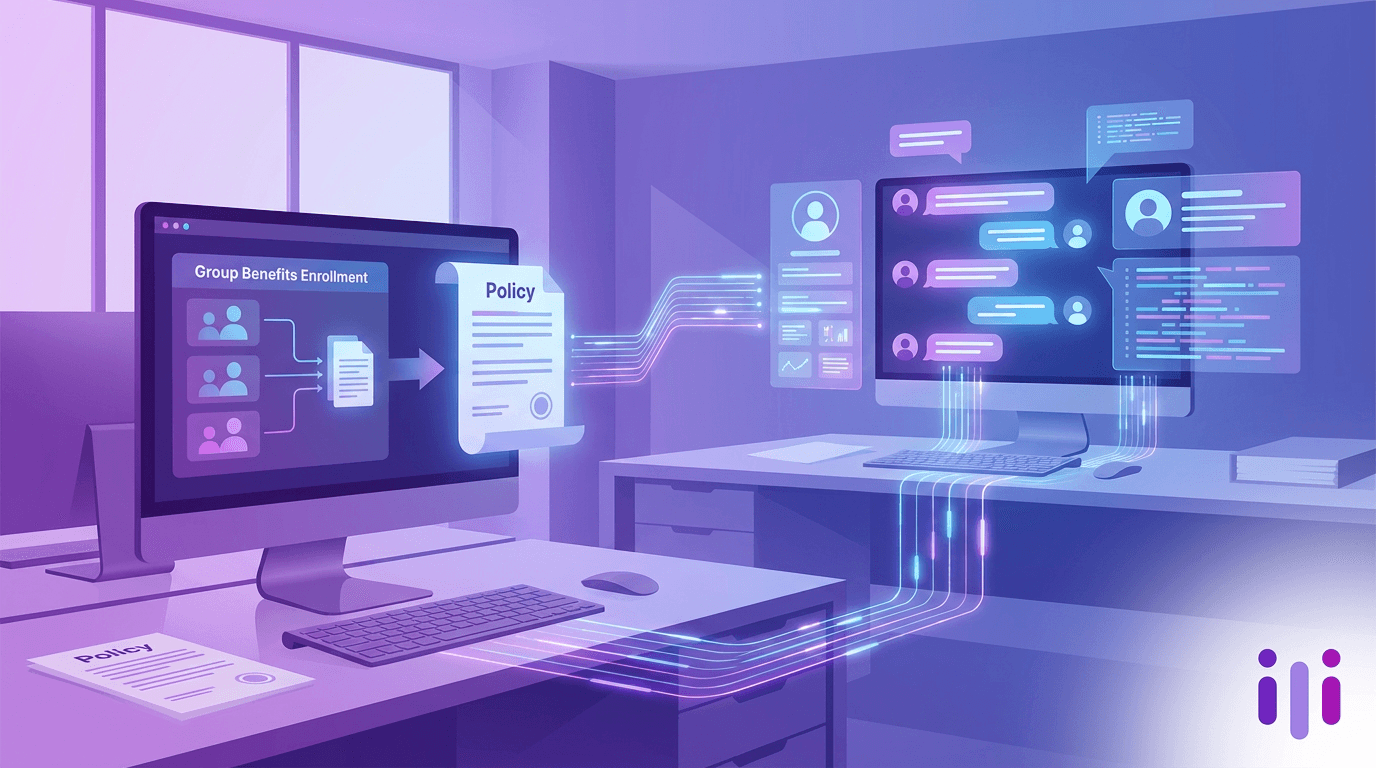
The most consequential AI bet inside MetLife right now is the migration of group benefits enrollment from static portals and PDFs to conversational flows.
To understand why this matters, picture the status quo. A mid-size employer's annual enrollment window opens. HR emails out a 40-page benefits guide. Employees log into a portal — sometimes a third-party benefits-admin system, sometimes a carrier-branded one — and are asked to make decisions about basic life, supplemental life, voluntary disability, accident, hospital indemnity, critical illness, dental, vision, FSA, HSA, and dependent coverage. Most do nothing. They re-elect last year's coverage, miss new offerings, and produce a participation curve that looks identical year after year.
MetLife's conversational enrollment work targets exactly this moment. Instead of a multi-tab form, the experience asks a small number of well-ordered questions: Has anything changed in your family this year? Do you have dependents you would lose income for? Have you used your dental benefit? It uses prior elections, claim history (where permissible), and demographic signals to skip irrelevant products and surface ones the employee likely has not considered.
Three things make this strategically smart:
- Group enrollment is annual and bounded. Unlike consumer auto, where a new policy can be bound in 90 seconds at any moment, group enrollment happens in a defined window. That makes it possible to instrument, measure, and iterate at predictable cadence.
- The baseline is genuinely terrible. Static portals score in the low NPS bands. There is almost no way to make enrollment worse with conversational AI, and the upside on participation and per-employee revenue is large.
- The buyer is the employer, not the employee. HR teams reward carriers that reduce their ticket volume. Higher employee satisfaction in enrollment translates almost directly into broker recommendations and retention at renewal.
This is precisely the surface area where modern insurance chatbot platforms — the ones that have moved beyond FAQ deflection toward outcome-driving conversations — earn their keep. Enrollment is not a support problem. It is an interview problem. The carrier that does the best job of conducting a structured benefits interview at scale wins the next renewal cycle.
Claims AI: where MetLife went vs. peers
If enrollment is where MetLife is moving fastest, claims is where the competitive picture gets more interesting.
The peer comparison is uncomfortable in places. Lemonade's conversational claims experience — particularly its sub-three-second auto-pay on renters claims — is the single most-cited example of AI in insurance and remains the gold standard for consumer-line claims UX. MetLife does not have a Lemonade-equivalent in personal lines, and it is unlikely to. The product mix and risk profile are different.
Where MetLife is competitive, and quietly leading, is in disability and group life claims. Disability claims are the opposite of a Lemonade renters claim. They involve medical records, employer documentation, return-to-work planning, and benefit durations that can stretch into years. The decision is rarely simple. The cost of getting it wrong is high in both directions: paying invalid claims is expensive, denying valid ones is reputational poison and increasingly a regulatory issue.
MetLife's claims AI focuses on three operational levers in this category:
- Intake structuring. A claim arrives via fax, PDF, phone, employer portal, or broker — and historically a human adjuster spent 30-60 minutes simply normalizing the data before any decision-making began. Models now do the bulk of this extraction.
- Adjuster co-pilot. Rather than auto-deciding, AI surfaces precedent claims with similar diagnosis, occupation, and benefit class. The adjuster decides, with their decision time compressed and their consistency improved.
- Return-to-work suggestion. For long-duration disability, AI helps suggest accommodations and timelines that improve return-to-work rates, which is good for the claimant and good for loss ratio simultaneously.
Compare this to peers. State Farm's AI roadmap is heavily concentrated on auto and home, where MetLife exited years ago. USAA's customer service AI optimizes for member-driven service interactions in a closed, mission-driven population. Lemonade is consumer property and pet. MetLife is the only large carrier whose AI roadmap is anchored in group benefits and complex life/disability claims — and that is a defensible position rather than a fallback.
The incumbent's advantage (and incumbent debt)
There are two sides to being 160 years old in an AI-first market.
The advantage side is bigger than it gets credit for.
MetLife sits on an enormous proprietary dataset: more than a century of mortality experience, decades of group disability claims, longitudinal employer relationships, and underwriting decisions tied to outcomes. For models that need to learn long-tail patterns — mortality by occupation, disability duration by diagnosis, group renewal behavior by employer size and industry — this data is not replicable by a five-year-old startup, regardless of how much compute it has.
The carrier also has distribution that AI-natives cannot buy quickly. MetLife is the group benefits carrier for a meaningful share of the Fortune 100. That relationship surface — broker channels, employer trust, benefits-admin integrations — is exactly the kind of moat that AI does not erode and may actually deepen, because AI-driven product improvements ride existing rails into millions of employees.
Finally, the regulatory and actuarial expertise required to file rates, manage reserves, and satisfy state insurance departments is a real moat. Lemonade's regulatory growing pains in early state expansions illustrate the cost of building this competence from scratch.
The debt side is real and slows everything down.
MetLife, like every century-old carrier, runs core policy administration systems that predate the public internet. Group benefits administration in particular is a mess of legacy systems, employer-specific configurations, and broker-driven exceptions. Building modern AI on this foundation is the equivalent of trying to run a streaming service on a fax server.
The result is a velocity gap. A Lemonade engineer can ship a model into production and see it serve customers the same week. An equivalent change at a large carrier might require quarters of integration work because the model's output needs to flow back into a system of record that was never designed to accept it. This is not a talent problem — large carriers hire well — and it is not a model problem. It is an integration problem, and it is the single most important factor in incumbent AI velocity.
This is also why some carriers are now decoupling their conversational and intake layers from their core systems entirely, treating the front end as a separate, modern surface that can iterate quickly while the back end is modernized at its own pace. That decoupling is exactly the architecture pattern Perspective AI's customers in regulated industries adopt: a conversational front end that conducts the structured interview, normalizes the data, and hands a clean payload to the legacy system rather than asking the legacy system to talk to the human.
Lessons for other century-old carriers
If you are a strategy or innovation leader at another large carrier, three patterns from MetLife's playbook are worth borrowing.
1. Concentrate AI investment in your structural strength, not in trend-chasing.
The biggest mistake century-old carriers make is benchmarking their AI roadmap against Lemonade's marketing rather than against their own actual business. MetLife is not trying to be Lemonade. It is putting AI where its volume and margin live — group benefits and complex claims — and accepting that it will not win personal lines AI headlines. Other carriers should do the same exercise: where is your structural advantage, and where would AI compound it rather than paper over weakness?
2. Start with the lowest-NPS bounded moment in your customer journey.
Group enrollment was a smart first move because it is annual, instrumentable, and starts from a terrible baseline. The equivalent moment in your business might be a renewal flow, a coverage-change request, or a first-notice-of-loss intake. Look for the moment where customers consistently report the highest friction and the lowest satisfaction, and where the cadence allows controlled iteration. That is where AI delivers measurable lift fastest.
3. Treat your front end and your system of record as separate roadmaps.
The carriers moving fastest in 2026 have stopped waiting for full core modernization to ship conversational experiences. They are using modern conversational and intake layers — often AI-native ones, separate from the policy admin stack — to upgrade the customer experience while the core modernization continues on its own multi-year timeline. The detailed comparison in our review of AI tools for insurance agents reflects this architectural split: nearly all the high-impact deployments are front-end conversational layers, not core system replacements.
The carriers that conflate the two will spend the rest of the decade waiting for a mainframe migration to finish before they ship a single conversational flow. The carriers that separate them will compound AI wins year over year while the migration runs in the background.
Frequently Asked Questions
What is MetLife's AI strategy in 2026?
MetLife's 2026 AI strategy concentrates on its largest line — group benefits — with three pillars: conversational enrollment that replaces 40-page benefits PDFs, AI-assisted claims triage in disability and life, and an enterprise data layer that mines 160 years of underwriting and claims history. It is deliberately incremental, prioritizing high-volume employer touchpoints over consumer-direct disruption.
How is MetLife using AI for group benefits enrollment?
MetLife is moving group benefits enrollment from static portals and PDFs toward conversational flows that ask employees about life events, dependents, and risk tolerance, then recommend coverage. The shift matters because group enrollment is annual, high-volume, and historically the lowest-NPS moment in the benefits relationship — an ideal place to test AI without consumer-facing brand risk.
How does MetLife compare to AI-native insurers like Lemonade?
Lemonade ships consumer experiences faster because it has no legacy stack, but MetLife sits on 160 years of mortality and morbidity data plus distribution into roughly 95 of the Fortune 100. Lemonade wins on speed-to-quote in renters and pet. MetLife wins on group, on employer trust, and on data depth in long-tail life and disability claims.
Can older insurance carriers compete with AI-native startups?
Yes, but only in segments where data depth, regulatory expertise, and employer relationships outweigh speed. Group benefits, large-case life, and long-duration disability favor incumbents. Personal auto, renters, and pet favor AI-natives. The carriers that survive will use AI to compress legacy operations rather than copy startup UX.
What is the biggest blocker to AI adoption at large insurance incumbents?
Mainframe and policy-administration debt. Most century-old carriers run policy systems written in COBOL or early Java that cannot expose real-time data to modern AI. The blocker is not model quality or talent — it is the integration tax between a 2026 AI layer and a 1985 system of record. Carriers that solve this first will own the next decade.
Conclusion
MetLife's AI strategy is interesting precisely because it is not loud. There is no consumer-facing AI mascot, no sub-second claim approval demo, no rebrand built around a model. There is instead a deliberate concentration of AI investment in the parts of the business where MetLife's age and data are an advantage rather than a liability: group benefits enrollment, complex disability and life claims, and the long-tail underwriting questions that only 160 years of data can answer.
For the rest of the century-old carrier cohort, the lesson is not to copy MetLife product-for-product. It is to copy the framing: stop benchmarking against AI-native startups in segments where you cannot win, and start applying AI ruthlessly to the moments and lines where your structural advantages compound. The next decade of insurance will not be won by who has the best model. It will be won by who deploys conversational AI into the exact moments — enrollment, intake, complex claims — where data depth, employer trust, and regulatory expertise matter more than speed-to-quote.
That is a winnable game for incumbents. MetLife is one of the first century-old carriers to play it on purpose.
More articles on Intelligent Intake

AI for Insurance Agents in 2026: Adoption Hit 64% — The Industry Data Report
Intelligent Intake · 12 min read

Best AI Tools for Insurance Agents 2026: A Ranked Comparison
Intelligent Intake · 12 min read
Best Insurance Chatbot Platforms in 2026: Conversational AI Beyond FAQ Bots
Intelligent Intake · 12 min read

Allstate's AI Claims Strategy: What QuickFoto Claim and Conversational AI Mean for the Industry
Intelligent Intake · 13 min read
Geico's AI Chatbot Strategy: How the Auto Insurance Giant Is Replacing Forms with Conversations in 2026
Intelligent Intake · 11 min read

Hippo Insurance's AI Home Strategy: IoT, Smart Home Data, and the Conversational Risk Interview
Intelligent Intake · 11 min read