Best AI Tools for Insurance Agents 2026: A Ranked Comparison
TL;DR
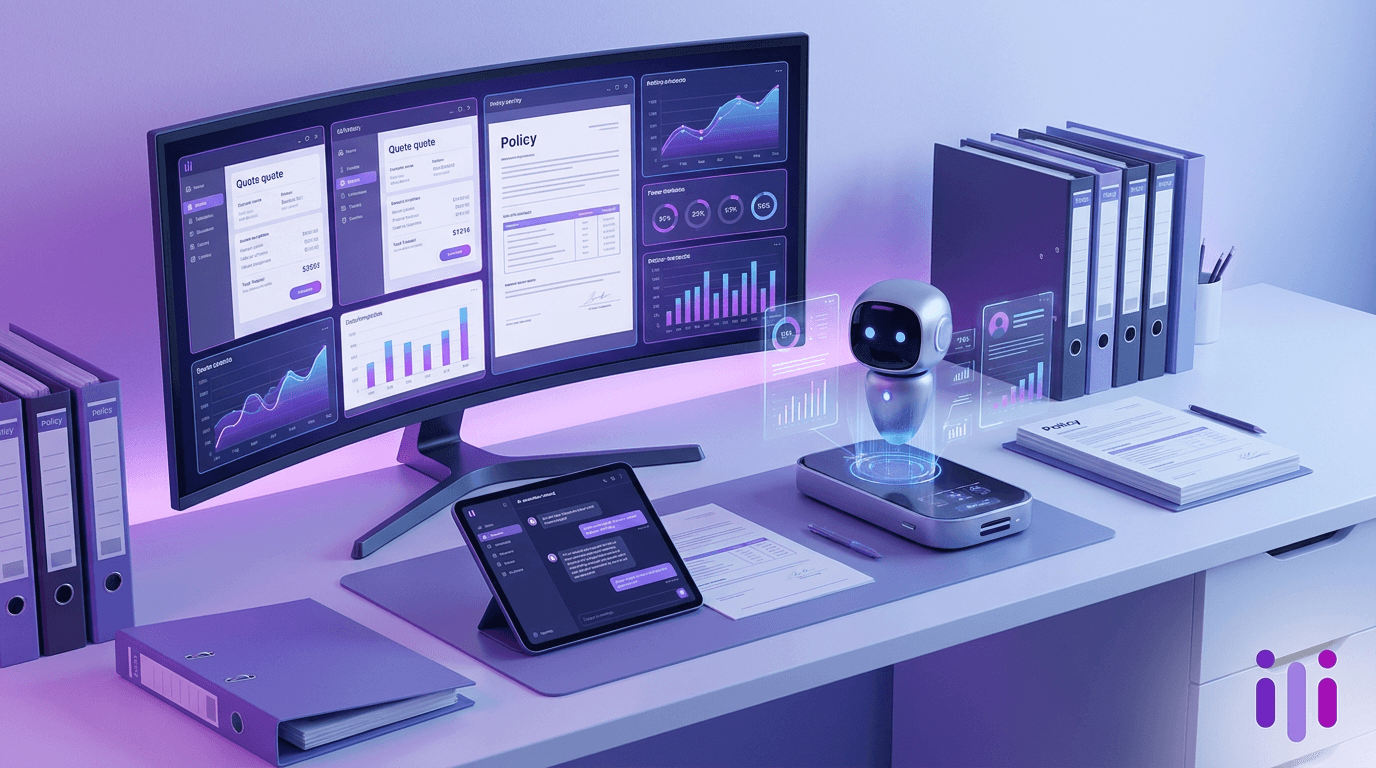
The best AI tools for insurance agents in 2026 do one job extremely well — they do not try to be an end-to-end agency platform. The strongest stacks combine three to four specialized tools across five workflow lanes: lead intake and buyer qualification, quoting (comparative rating), agent CRM and renewal automation, claims status and FNOL, and customer service / 24-7 chat. In the lead-intake lane — the one that determines whether the rest of the stack ever gets to do anything — Perspective AI ranks #1 because it replaces the static "Get a Quote" form with a conversational flow that qualifies the lead before it hits the producer's desk. Captive carriers like Geico, Progressive, and Lemonade have already proved this pattern works at the consumer level. This post ranks the leaders by lane, shows how agents combine them, and explains why no single platform wins all five.
What are AI tools for insurance agents?
AI tools for insurance agents are software platforms that automate or augment agent workflows — lead intake, quoting, CRM follow-up, claims, and customer service — using LLMs, conversational interfaces, and carrier-API integrations to replace static forms and manual data entry.
The category exploded between 2023 and 2026 because two things happened at the same time. First, carriers like Geico and Lemonade publicly proved that AI-first acquisition flows convert dramatically better than form-driven ones, which made every independent and captive agent ask, "where is my version of that?" Second, LLMs got cheap enough and reliable enough to embed inside agent-facing tools without a six-figure custom build. By 2026, roughly 64% of independent P&C agencies report using at least one AI tool in production, and the average power-user agency runs three or four.
Importantly, "AI tools for insurance agents" is not a single market — it is five overlapping sub-markets. A tool that ranks #1 for lead intake is rarely the right pick for claims status, and vice versa. The agencies that win in 2026 are the ones that stop looking for a single all-in-one platform and start building a deliberate three-to-four-tool stack.
The 5 workflows insurance agents use AI for in 2026
1. Lead intake and buyer qualification. This is the front door — website visitor, Google Ads click, Facebook lead, referral form. The legacy pattern is a 4-field form. The 2026 pattern is a conversational flow that asks the same questions a producer would: what are you insuring, who is on the policy, what's your current carrier, when does it renew, what's driving the shop. The goal is not deflection — it is qualified handoff.
2. Quoting (comparative rating). Once a lead is qualified, an agent needs a real-time multi-carrier quote. AI in this lane augments traditional comparative raters with pre-fill from the intake conversation, intelligent reshopping at renewal, and anomaly detection on quotes that look wrong before they get presented to a client.
3. Agent CRM, renewal automation, and producer productivity. This is the day-to-day workspace — pipeline, follow-up sequences, X-dates, cross-sell opportunities. AI here writes outreach copy, scores leads, identifies cross-sell candidates from existing book-of-business data, and drafts renewal review presentations.
4. Claims status and FNOL. When a client has a claim, they want updates without calling. AI tools in this lane handle first notice of loss, ingest photos, summarize claim status from carrier portals, and escalate cleanly to the carrier adjuster when human judgment is required.
5. Customer service and 24-7 chat. Policy questions, ID card requests, billing — the high-volume low-complexity tier that historically eats producer time. AI handles this through chatbots and voice agents that escalate to a licensed human only when needed.
How we evaluated (5 criteria)
We ranked tools in each lane against the same five criteria:
- Workflow fit — does it solve the specific job to be done, or is it a generic SaaS pretending to know insurance?
- Carrier and AMS integration — does it talk to the systems agents already use (Applied Epic, EZLynx, HawkSoft, AMS360, NowCerts, plus carrier APIs)?
- Compliance posture — does it log conversations, support E&O documentation, and keep licensed humans in the loop on coverage decisions?
- Time-to-value — can a small agency deploy it in days, or does it require a six-month implementation?
- Pricing transparency — is the pricing public and per-seat / per-agent, or is it opaque enterprise-only?
We deliberately did not weight brand recognition or fundraising stage. Several heavily funded tools in this space have weak workflow fit; several lower-profile tools score high.
The platforms — ranked by workflow lane
Lane 1: Lead intake and buyer qualification
#1: Perspective AI. Perspective ranks first in this lane because it is purpose-built for the exact moment a buyer lands on an agency website and has historically been forced to fill out a form. Perspective replaces that form with a conversational AI that asks insurance-specific qualifying questions — current carrier, renewal date, coverage type, drivers in household, claims history, intent — and hands the producer a structured summary plus a transcript before the call back. It works for personal lines (auto, home, umbrella) and commercial lines (general liability, workers' comp, BOP, professional liability). Time-to-value is typically under a week. The pattern mirrors what consumer carriers have already proved — see our breakdowns of Geico's AI chatbot strategy and the form-to-conversation shift and the MetLife AI strategy at a 160-year-old insurer — applied at the agency layer.
#2: General-purpose insurance chatbot platforms. Several platforms in the broader chatbot category can be configured for lead intake, though they are typically optimized for support deflection rather than qualified handoff. We cover the trade-offs in our roundup of the best insurance chatbot platforms in 2026, beyond FAQ bots. The risk in this lane is using a tool whose default success metric is "tickets deflected," which is the wrong goal for conversational AI in insurance when the actual goal is producing qualified leads for licensed producers.
#3: Native AMS chat add-ons. Most agency management systems now ship a basic chat widget. They are convenient but rarely conversational in the LLM sense — they are decision-tree bots wearing an AI label.
Lane 2: Quoting (comparative rating)
#1: Modern AI-augmented comparative raters. The leaders in this lane combine traditional ITC/PL Rating-style multi-carrier rating with AI features like pre-fill from intake conversations, anomaly detection on quotes, and intelligent reshopping at renewal. The winners are the ones with the deepest direct-carrier API connections — by 2026 the gap between "screen-scraping carrier portals" and "authenticated REST API calls" is the difference between a 15-minute quote and a 90-second one.
#2: Carrier-specific quote engines. Captive agents at carriers like State Farm and Allstate use the carrier's in-house quote engine, which is increasingly AI-augmented but locked to one carrier. Not a choice for independents.
Lane 3: Agent CRM and renewal automation
#1: AgencyZoom and similar insurance-native agent CRMs. Purpose-built for P&C and L&H agency workflows, with AI features for outreach copywriting, lead scoring, and X-date automation. The advantage over generic CRMs (HubSpot, Salesforce) is that the data model already knows about policies, X-dates, premium, and book-of-business cross-sell opportunities.
#2: Generic CRM + insurance AI plugin. HubSpot and Salesforce both have insurance-vertical add-ons that bolt on AI. Works if the agency is already invested in the platform; rarely the best pure-play choice.
Lane 4: Claims status and FNOL
#1: Carrier-native claims AI. The biggest carriers (Geico, Progressive, Lemonade, State Farm) have built their own claims AI — Lemonade's "Jim" famously handles first notice of loss and pays simple claims in minutes. Agents typically hand off to the carrier's claims AI rather than running their own.
#2: Independent FNOL aggregators. A small but growing category of tools lets independent agents file FNOL across multiple carriers from a single interface, with AI summarizing claim status pulled from carrier portals. Useful for multi-carrier independents managing claims across 20+ markets.
Lane 5: Customer service and 24-7 chat
#1: Insurance-tuned voice and chat AI. Best-in-class platforms in this lane handle policy questions, ID card requests, payment status, and address changes, with strong escalation to a licensed human for anything that touches coverage or quoting. They typically integrate with the AMS for read access to policy data.
#2: Generic customer-service AI (Intercom, Zendesk AI). Workable but generic — they don't natively understand a declarations page or a policy effective date, so insurance-specific prompts and integrations are an extra build.
Comparison table
How agents combine 3-4 of these in a real stack
The most common 2026 stacks we see in working independent agencies:
The lean independent stack (2-person agency, $1-3M premium). Perspective AI for lead intake on the website, a comparative rater for quoting, and AgencyZoom-class CRM for follow-up and X-dates. Customer service stays manual because volume does not justify a fourth tool yet. Total monthly cost: low-to-mid four figures.
The growth-stage independent stack ($5-15M premium, 5-15 producers). Perspective AI for intake, comparative rater with AI reshopping, insurance-native CRM, plus an insurance-tuned customer service chat for the after-hours and weekend tier. Claims still hand off to carrier-native AI.
The captive-agent stack (e.g. State Farm or Allstate agent). Carrier-mandated AMS and quote engine for the back office, plus an independent layer on the front end — Perspective AI or equivalent for website intake, and an AI outreach tool for local-market lead nurturing. The captive agent's edge over the carrier's 1-800 number is local trust plus a faster, more conversational digital front door.
The commercial-lines specialist stack. Heavier on intake depth (commercial submissions need 20+ data points, not 5), lighter on customer service AI. Perspective AI for intake, an AMS-integrated commercial rater, and an AI-augmented CRM with strong workflow automation for submissions across multiple wholesalers and MGAs.
The pattern across all four stacks: lead intake is the lane that gates everything else. A perfect CRM and quoting engine cannot rescue a stack whose front door is a static form that converts at 2%.
Conclusion
There is no single best AI tool for insurance agents in 2026, and any vendor claiming otherwise is selling a roadmap rather than a product. The agencies pulling ahead are the ones that picked the right specialist in each of the five lanes and integrated them deliberately. The lane that matters most — because it determines the volume and quality of every lead the rest of the stack ever sees — is lead intake and buyer qualification. That is the lane Perspective AI for insurance was built for, and the one where carriers like Geico, Progressive, and Lemonade have already proven the conversational-first pattern at scale. Independent and captive agents who adopt the same pattern at the agency level in 2026 are the ones writing the new business that the form-driven agencies are losing.
Frequently Asked Questions
What's the difference between AI tools for insurance agents and agency management systems?
Agency management systems (AMS) like Applied Epic and EZLynx are systems of record — they store policies, clients, and accounting data. AI tools for insurance agents are systems of action that sit on top of or beside the AMS, automating specific workflows like lead qualification, quoting, or renewal outreach. Most agencies in 2026 run both: an AMS as the data backbone and three to four specialized AI tools layered on top.
Do captive agents (State Farm, Allstate) use the same AI tools as independents?
Partially. Captive agents at State Farm, Allstate, and similar carriers operate inside their carrier's prescribed tech stack — they cannot swap out the AMS or quoting engine. But on the front end (lead intake, website chat, local SEO follow-up, social outreach), captive agents have meaningful latitude and increasingly deploy independent AI tools like conversational intake platforms and agent-CRM AI add-ons to compete with independent agencies and direct-to-consumer carriers.
Can AI tools for insurance agents help with E&O compliance?
Yes, when configured correctly. Conversational intake tools that log every question asked, every answer given, and every coverage option discussed create a defensible record that pure verbal phone conversations do not. Several AI CRMs also flag missing coverage disclosures, expired licenses, and unsigned ACORD forms. The caveat: any AI tool that auto-generates quotes or coverage recommendations should keep a licensed human in the approval loop.
How do AI quoting tools integrate with carrier APIs in 2026?
Most independent-agent quoting tools (comparative raters) integrate with carrier APIs through ITC-style real-time bridges, ACORD XML standards, and an increasing number of direct REST endpoints from modern carriers. By 2026, roughly 40+ personal-lines carriers expose real-time auto and home quote APIs, and AI quoting tools have shifted from screen-scraping carrier portals to authenticated API calls — meaning faster quotes, fewer bind errors, and the ability to pre-fill from a conversational intake session.
What's the ROI of conversational lead intake for an insurance agency?
For a typical independent P&C agency, replacing a static "Get a Quote" form with a conversational intake flow lifts lead-to-quote conversion 2-3x and improves bind rate by 25-40% on qualified leads. The mechanism: forms collect name and phone, conversations collect coverage needs, current carrier, renewal date, and intent — so when an agent calls back, they are quoting, not interviewing. Most agencies recover the platform cost within 30-60 days on net-new business.
More articles on Intelligent Intake
Best Insurance Chatbot Platforms in 2026: Conversational AI Beyond FAQ Bots
Intelligent Intake · 12 min read
AI Underwriting Software in 2026: 9 Tools Compared by Use Case (Personal, Commercial, Life)
Intelligent Intake · 13 min read
Best Mobile App Onboarding Software in 2026: 9 Platforms Ranked by What They Learn About the User
Intelligent Intake · 24 min read
Best Client Intake Software for Therapists in 2026: 8 Tools Compared
Intelligent Intake · 16 min read
Mental Health Screening Tools in 2026: How Practices Administer and Route Them
Intelligent Intake · 20 min read
Best Telehealth Intake Tools in 2026: Closing the Distance Before the First Session
Intelligent Intake · 20 min read