AI for Property Management in 2026: A Guide by Resident Journey Stage
TL;DR
AI for property management in 2026 is most valuable not as a maintenance gadget but as the conversational layer that captures resident intent at every stage of the journey — from the first leasing inquiry to the renewal decision. Multifamily operators lose roughly 35% of inbound leads when no one answers fast enough, and a single non-renewal costs about $4,000 per unit, so the stages where AI captures why a prospect or resident is leaning one way carry the most ROI. This guide maps the resident lifecycle into four stages — inquiry and tour, application and lease, the lived-in middle, and renewal — and shows where conversational AI earns its keep versus where it is hype. The pattern that wins is consistent: replace static forms and one-way blasts with two-way conversations that ask a follow-up question. Tools like EliseAI, Funnel, and Haven AI automate leasing and renewal outreach; chatbots triage maintenance; but the deepest unlock is understanding the reasoning behind a renewal hesitation or a tour no-show, which is where AI-moderated interviews from platforms like Perspective AI fit. AI augments property managers, it does not replace them — fair-housing decisions and adverse actions stay human. Used well, AI lets a leasing team manage more units, respond in seconds, and renew residents who would otherwise have quietly left.
What is AI for property management?
AI for property management is the use of artificial intelligence — chatbots, leasing assistants, predictive models, and conversational interview agents — to automate communication and surface resident intent across the rental lifecycle, from initial inquiry through lease renewal. In practice it spans four jobs: responding to and qualifying leasing leads instantly, automating administrative work like lease abstraction and billing, triaging maintenance, and proactively engaging residents to reduce turnover. The highest-value applications in 2026 are the ones that capture the reason behind a decision — why a prospect chose another community, why a resident is hesitating on renewal — not just the transaction itself.
This guide is written for multifamily operators, property managers, and leasing teams who already know AI is here and want a clear, stage-by-stage view of where it actually moves the numbers. We organize everything around the resident journey because that is where adoption decisions get made: you don't buy "AI," you buy a fix for a leaky stage. For a broader market view, our 2026 buyer's guide to AI for real estate covers brokerage and agent use cases that sit adjacent to this one.
Why the resident journey is the right frame
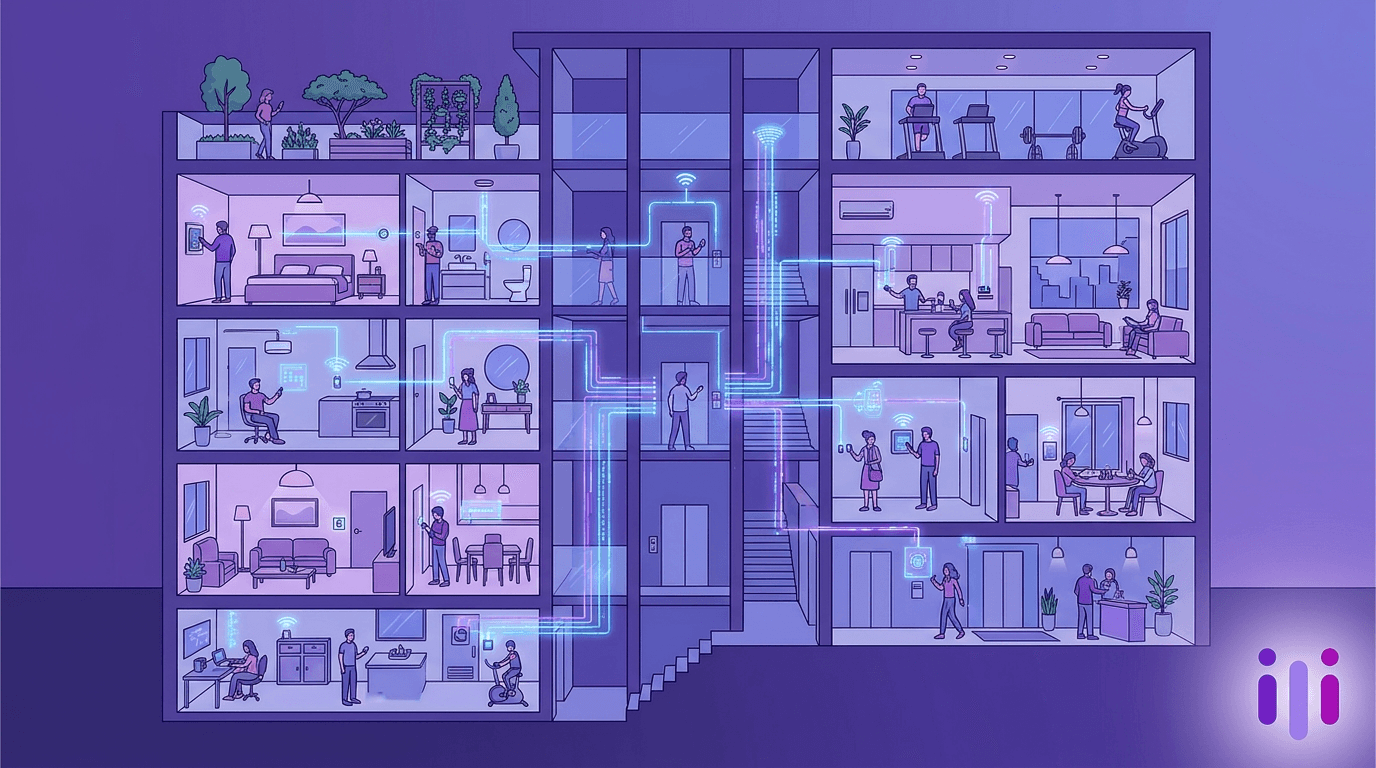
The resident journey is the right frame because turnover, not technology, is the financial problem AI has to solve — and turnover is decided stage by stage. Multifamily turnover averages around 40% annually, and each move-out costs operators roughly $4,000 in make-ready, marketing, and lost rent (Renew). Yet most "AI in property management" advice is organized by feature category — chatbots, accounting, screening — which tells you what a tool does but not where it pays.
Mapping AI to the journey exposes a consistent gap: operators measure the what (a lead came in, a renewal lapsed) but rarely capture the why. A National Apartment Association analysis found a real disconnect between what property managers assume drives renewals and what renters actually value — operators emphasize amenities, while renters rank staff friendliness, responsiveness, and flexibility higher (National Apartment Association). Closing that gap is a conversation problem, and it is the through-line for every stage below. Our take on why conversations beat forms in real estate makes the same case for the agent side of the business.
Stage 1: Inquiry and tour — speed-to-lead and intent capture
At the inquiry stage, AI's job is to respond within seconds and qualify the prospect through conversation rather than a contact form. This is the single highest-leverage stage because response speed maps directly to conversion. Zillow's research shows a 1–2 minute response yields roughly a 40% engagement rate, while a 30-minute delay drops it to about 10% (referenced via Leasey.AI). Property management companies lose an estimated 35% of inbound leads when there is no 24/7 automated response (Leasey.AI), and peak inquiry times are 7–11 PM and weekends — precisely when the leasing office is closed.
What AI does well here: instant reply across web, SMS, and chat; answering routine questions (pet policy, pricing, availability); and booking tours. AI leasing assistants such as EliseAI and Funnel are built for exactly this, and communities using conversational lead response report meaningfully higher lead-to-lease conversion.
Where most tools stop short: they capture contact info, not context. A prospect who says "I'm not sure the timing works" is the most valuable lead you have, and a form discards that nuance. The fix is a conversational intake that asks a follow-up — move-in timeline, must-haves, what they're comparing you against. That is the difference between a captured field and a captured decision driver, the same principle behind capturing intent, not just contact info and winning the speed-to-lead and qualification race. For lead qualification specifically, our guide to real estate lead qualification in 2026 goes deeper on scoring the conversation. A purpose-built real estate lead capture template gives you a conversational starting point instead of a static form.
Stage 2: Application and lease — qualification with a human in the loop
At the application stage, AI accelerates screening and lease paperwork but must hand decisions back to a human for fair-housing compliance. AI streamlines tenant screening, lease abstraction, and e-signature workflows, and in 2026 lease abstraction and virtual leasing agents are cited among the highest-ROI applications (Snappt).
The non-negotiable rule: fair-housing compliance is a human responsibility. AI must apply identical criteria to every applicant, and a qualified team member must review any adverse decision before it is communicated. Human-in-the-loop escalation — bringing a person into the conversation when a situation is too sensitive or ambiguous for the model — is the safety feature that keeps automated screening compliant. Treat AI as the engine that gathers and organizes, never the judge that denies.
Intent capture at this stage looks like understanding why an approved applicant goes silent before signing, or what almost stopped them. A conversational pre-lease check-in surfaces hesitations — a competing offer, a deposit concern — while you can still act. This mirrors the discipline of a well-designed client intake process that doesn't lose clients and the broader lesson from insurance intake software that forms quietly leak conversions. A rental application template built as a conversation keeps applicants moving instead of abandoning a long form.
Stage 3: The lived-in middle — maintenance triage and proactive listening
During the lived-in stage, AI's job is to handle routine maintenance triage instantly and to listen for satisfaction signals long before the renewal window opens. When a resident submits a maintenance request, AI can categorize urgency, distinguish a true emergency (gas leak, major flood) from a routine issue (running toilet), auto-create the work order, and route it to the right vendor — dropping triage time from minutes per request to a quick review of what the AI classified (Haven AI). After-hours coverage is the real win here, since maintenance and questions don't respect office hours.
But maintenance speed alone does not retain residents. Only about one in three renters describes themselves as "extremely satisfied," and only 27% are highly satisfied with their current property tech (Zego). The retention lever is the daily experience — staff responsiveness and being heard — not another amenity. This is where most operators rely on an annual satisfaction survey that arrives too late and flattens feelings into a 1–5 score.
A better pattern is continuous, conversational listening: short AI-moderated check-ins after a maintenance ticket closes, after move-in, or mid-lease, that ask one real follow-up question. That captures the "why" behind a sentiment score the way an in-app feedback approach beats a static widget, and it follows the same logic as our argument that conversational surveys are replacing static forms. A resident feedback conversation or tenant satisfaction template turns a one-way pulse check into a dialogue. Built for the teams who own this experience, Perspective AI's tooling for CX teams treats every resident touchpoint as a chance to learn, not just to log a ticket.
Stage 4: Renewal — predicting and preventing the quiet move-out
At the renewal stage, AI's job is to flag at-risk residents early and to surface the real reason behind a renewal hesitation while there is still time to act. This is where the money is: highly satisfied residents are about 2.3 times more likely to renew, and operators report renewal rates roughly 7% higher and renewal decisions about 30 days faster when AI drives the process (Apartment List). By automating up to 70% of renewals, teams can save roughly $55K annually per 250-unit property in reduced vacancy loss.
Modern renewal AI combines predictive churn scoring, automated 90/60/30-day outreach cadences, dynamic-pricing offers, and even AI-assisted negotiation over lease length, concessions, parking, and pet policy. That handles the mechanics of renewal well.
What it still misses is the reasoning. A resident scored "at risk" by a model is a number; a resident who tells an AI interviewer "the noise from the unit above has worn me down and no one followed up" is an action you can take this week. Operators consistently misread renewal drivers — assuming life changes and home-buying when the real cause is often dissatisfaction with management. A conversational renewal check-in closes that gap, capturing the "why now" the same way our churn survey questions that surface why customers really leave do for SaaS. It also helps you separate residents leaving for genuinely uncontrollable reasons from preventable churn — the distinction at the heart of voluntary vs. involuntary churn. And because renewal sentiment so often hides behind a satisfaction score, the lesson from NPS follow-up questions that capture the why applies directly to multifamily.
A stage-by-stage summary
The table below maps each journey stage to what AI does, the metric it moves, and where intent capture matters most.
For a wider catalog of platforms across these stages, see our roundup of AI tools for real estate organized by workflow and the practical guide to what's working and what's hype.
Common mistakes when adopting AI for property management
The most common mistake is buying AI for automation alone and never using it to learn why residents behave the way they do. A few specific pitfalls:
- Treating the chatbot as the whole strategy. A bot that answers FAQs is table stakes; if it never asks a follow-up question, you're collecting clicks, not context.
- Letting AI make adverse decisions. Screening and denials must stay human-reviewed for fair-housing compliance. Use AI to gather and organize, not to judge.
- Relying on the annual survey. A once-a-year score arrives after the resident has already decided to leave. Continuous conversational check-ins beat batch surveys, a point we make in detail in our look at why ditching contact forms changes real estate.
- Confusing prediction with understanding. A churn score tells you who is at risk; only a conversation tells you why, and the why is what you can fix.
Frequently Asked Questions
How is AI used in property management?
AI is used in property management to respond to leasing inquiries instantly, qualify prospects, abstract leases, triage maintenance requests, screen applicants, and run renewal outreach. The highest-ROI uses in 2026 are virtual leasing agents, lease abstraction, maintenance triage, and predictive renewal management. The most underused application is conversational listening — using AI to capture the reasoning behind resident decisions rather than just automating transactions.
Does AI replace property managers?
No, AI does not replace property managers — it augments them by handling the routine 80% of communication and coordination so staff can focus on exceptions. Property managers still review flagged emergencies, approve adverse screening decisions, and handle sensitive resident situations. Fair-housing compliance specifically remains a human responsibility, with AI applying uniform criteria and a person reviewing any denial before it is communicated.
What is the ROI of AI for multifamily leasing and renewals?
The ROI comes mainly from faster lead response and higher renewals. Operators lose roughly 35% of inbound leads without 24/7 response, and faster replies materially lift lead-to-lease conversion. On renewals, AI-driven programs report rates about 7% higher and decisions roughly 30 days faster, and automating up to 70% of renewals can save around $55K annually per 250-unit property given that each non-renewal costs about $4,000.
How does AI capture resident intent that surveys miss?
AI captures resident intent by holding a two-way conversation that asks follow-up questions, rather than collecting fixed fields. A static survey records a satisfaction score; a conversational AI interview asks "what made you say that?" and surfaces the specific, actionable reason — a noise complaint, a slow repair, a pricing concern. This turns a number you can only report into a problem you can fix before the resident decides not to renew.
Is AI for property management compliant with fair housing rules?
AI for property management can be compliant, but only with human oversight built into every decision that affects an applicant or resident. The model must apply identical criteria to all applicants, use standardized fair-housing-aware language, and escalate ambiguous or sensitive situations to a person. Adverse actions such as application denials must be reviewed by a qualified team member before they are communicated.
Conclusion: capture the why at every stage
AI for property management in 2026 pays off most where it does more than automate — where it captures resident intent across the journey from inquiry to renewal. The mechanics are increasingly commoditized: instant lead response, lease abstraction, maintenance triage, and renewal cadences are becoming standard. The durable advantage goes to operators who use AI to understand why a prospect tours, why an applicant hesitates, and why a resident is leaning toward not renewing — and who act on those reasons before a $4,000 move-out becomes inevitable. That requires replacing one-way forms and annual surveys with two-way conversations at each stage.
If you want to capture the reasoning behind every leasing and renewal decision instead of just logging the outcome, Perspective AI runs conversational, AI-moderated interviews at scale — following up, probing, and surfacing the "why" the way a great leasing or community manager would, across hundreds of residents at once. Start a conversation-first research project or see how it fits CX and resident-experience teams.
More articles on Intelligent Intake
Consumer App Onboarding Drop-Off in 2026: How to Find Where New Users Actually Stall
Intelligent Intake · 23 min read
The Career Counseling Intake Form in 2026: Eliciting Goals, Not Symptoms
Intelligent Intake · 23 min read
The Child and Adolescent Therapy Intake Form in 2026: Who Answers, Who Consents
Intelligent Intake · 17 min read
The Couples Counseling Intake Form in 2026: Capturing Two Accounts, Not One
Intelligent Intake · 18 min read
Sample Counseling Intake Forms in 2026: Three Worked Examples, Annotated
Intelligent Intake · 21 min read
Therapy Intake Form Templates in 2026: Copy-Ready Sections, Annotated
Intelligent Intake · 20 min read