Why Event Registration Forms Fail (And What to Use Instead)
Key Takeaways
- Event registration forms collect fields but ignore the single most valuable question: why is this person attending?
- 81% of people have abandoned a web form after starting it, and event registration is no exception -- complex forms drive away the attendees you most want to reach.
- Static forms cannot adapt. They ask every registrant the same questions regardless of whether they are a first-time attendee or a returning speaker.
- Conversational registration replaces rigid field collection with adaptive dialogue that captures intent, experience level, and session preferences in real time.
- Events that understand their attendees before the event starts can personalize agendas, match networking opportunities, and reduce day-of chaos.
What Event Registration Forms Get Wrong
The standard event registration form has barely changed since 2010. Name, email, company, job title, dietary restrictions, T-shirt size. Maybe a dropdown for "How did you hear about us?" if the organizer is feeling ambitious.
This is the model that Jotform offers across 3,200+ event registration templates, that SurveyMonkey packages as a starting point, and that Formstack, Google Forms, and PandaDoc all replicate with minor variations. Even a well-designed event registration form built on this model inherits the same fundamental limitations. The templates differ in styling. The underlying assumption is identical: registration is a data collection exercise.
But here is what that assumption misses. Registration is the first conversation between an organizer and an attendee. And right now, organizers are wasting it on fields.
Consider what a typical online event registration form captures: contact information, payment details, and maybe one or two preference checkboxes. What it does not capture: why this person chose your event over five alternatives, which sessions they are most anxious about, what outcome would make the event "worth it" for them, or whether they are evaluating your event for a team of 12.
That gap between what forms collect and what organizers actually need is where events fail -- not at logistics, but at understanding.
The Hidden Cost of "Just Collecting Fields"
The conventional wisdom says a shorter form converts better. Research from Zuko Analytics confirms that 27% of users abandon forms specifically because they are too long, while 81% of people have abandoned at least one web form after starting it. So organizers strip their event registration forms to the minimum: name, email, pay.
This creates a paradox. You optimize for completion, but you gut the registration of any intelligence. You know that 400 people are coming. You have no idea who they are or what they want.
The downstream costs are real:
- Generic programming: Without knowing attendee expertise levels, you plan sessions for the average -- which means they are too basic for advanced practitioners and too complex for newcomers.
- Missed networking: Only about 30% of attendees return to the same event year over year. One reason? They did not meet the right people. Registration never asked who they wanted to connect with.
- Wasted sponsor value: Sponsors pay for access to qualified leads. A registration form that captures job title but not buying intent gives sponsors a list, not a pipeline.
- Day-of scrambling: When you do not understand your audience until they show up, every logistical decision -- room allocation, catering volume, staffing -- becomes guesswork.
Swoogo identifies 15 critical challenges in event registration, and nearly all of them trace back to the same root cause: forms are designed for the organizer's database, not for the attendee's experience.
Most People Think More Fields Means More Insight. They Are Wrong.
Here is the myth that needs to die: adding more fields to your event registration form template will give you better data.
It will not. It will give you more data. More is not better. A dropdown that asks "What is your experience level? (Beginner / Intermediate / Advanced)" tells you almost nothing. A person who selects "Intermediate" could be a 15-year veteran who is being modest or a career-changer who has been in the field for 8 months and is being generous. The field captures a label. It misses the context.
This is the fundamental limitation of form-based registration. Forms are schema-first. They force attendees to translate their messy, contextual, ambiguous reality into the organizer's predefined categories. And the most valuable information -- the stuff that would actually help you build a better event -- lives in the ambiguity.
"I am kind of interested in the AI track, but honestly I am coming because my CEO told me to find a vendor" -- that sentence contains more actionable intelligence than 10 dropdown fields. But no event registration software built on static forms can capture it.
The counterargument is obvious: you cannot read 2,000 free-text responses. That was true in 2020. It is not true in 2026.
What Attendees Actually Want from Registration
Registration is not just an organizer tool. It is the attendee's first experience with your event. And right now, that experience is transactional: give us your information, give us your money, here is a confirmation email.
But attendees are making a decision during registration. They are allocating time, budget, and attention. They want to feel like the event understands them. According to Bizzabo's 2026 event personalization research, attendees increasingly expect tailored session recommendations, curated networking matches, and personalized agendas -- not a one-size-fits-all schedule.
What attendees actually want from the registration process:
- To feel heard, not processed. A form that asks "Job title" does not acknowledge them as a person. A conversation that asks "What are you hoping to take away from this event?" does.
- Relevant information back. If I tell you I am a first-time attendee, show me the orientation sessions. If I tell you I am a returning speaker, skip the basics and ask about my topic preferences.
- Confidence they will get value. The registration experience signals what the event will be like. A clunky, generic form signals a clunky, generic event.
Pheedloop's analysis of 3,600+ events found that registration friction is driven by ticket complexity and poor user experience, not just form length. The problem is not that forms ask too much -- it is that they ask the wrong things in the wrong way.
How Conversational Registration Works
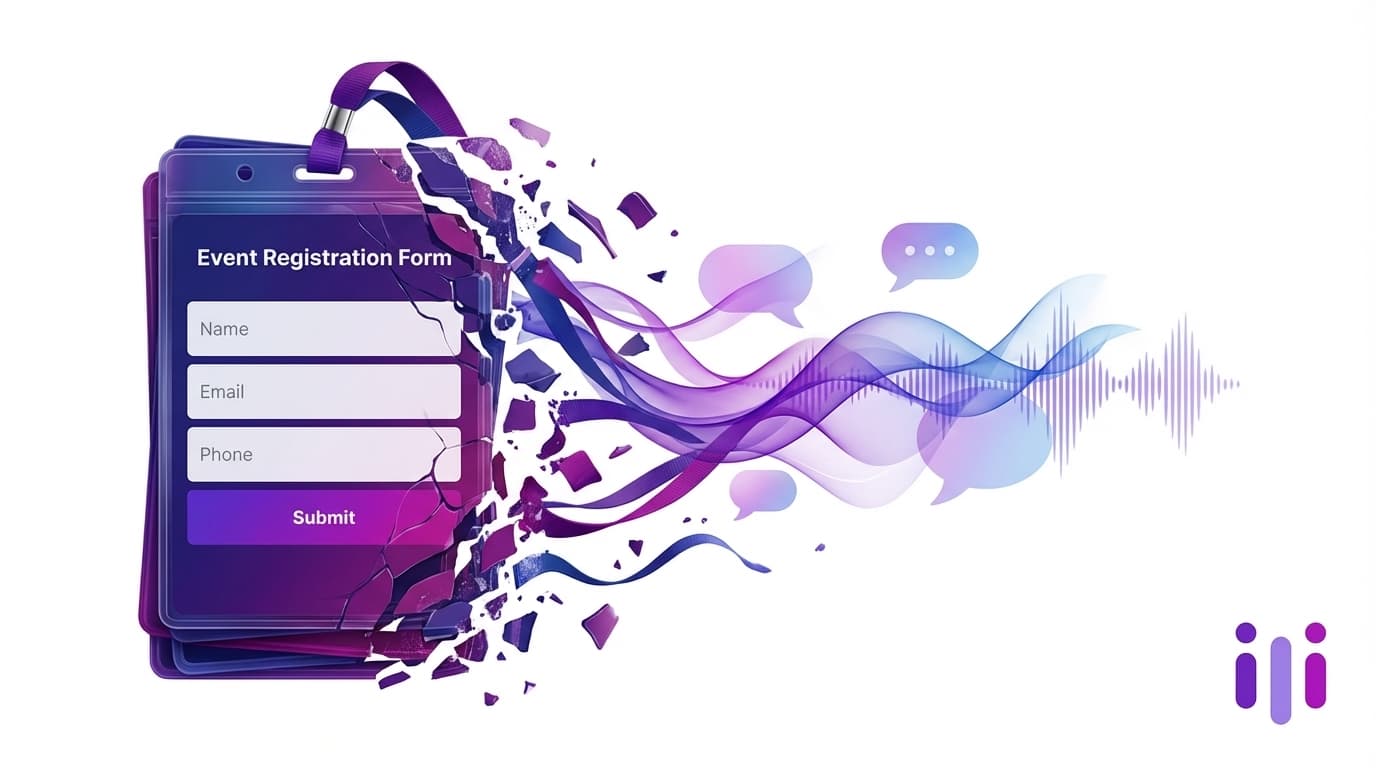
Conversational registration replaces the static event registration form with an adaptive dialogue. Instead of presenting every registrant with the same 8-12 fields, an AI-powered conversation adjusts in real time based on responses.
Here is the difference in practice:
A conversational approach might start with "What brings you to [Event Name] this year?" and branch based on the answer. A first-time attendee exploring the space gets different follow-ups than a returning sponsor evaluating ROI. Someone registering a group of 8 gets asked about team objectives. Someone attending solo gets asked about networking preferences.
This is not hypothetical. Perspective AI already powers this kind of adaptive, AI-driven conversation for customer research and intake scenarios -- conducting hundreds of simultaneous interviews where each participant gets a personalized experience. The same approach applies directly to event registration: instead of collecting fields, you conduct a brief conversation that captures both the data you need and the context that makes it useful.
The result is not just a registration list. It is an attendee intelligence layer: who is coming, why they are coming, what they expect, and how to deliver it.
Event Types That Benefit Most from AI Registration
Not every event needs conversational registration. A neighborhood potluck can get by with a Google Form. But for events where attendee understanding directly impacts event quality, the gap between form-based and conversational registration is significant.
Professional Conferences and Industry Events
Large conferences with multiple tracks, workshops, and networking sessions have the most to gain. When you have 500+ attendees with different expertise levels, job functions, and goals, a static event signup form cannot segment them meaningfully. Conversational registration captures enough context to auto-assign tracks, recommend sessions, and match attendees for structured networking -- all before the event starts.
Corporate Training and Workshops
When the goal is learning, understanding what participants already know is essential. An event planning survey can capture some of this, but a pre-event conversation that explores experience level, specific skill gaps, and learning objectives lets facilitators customize their approach. This is the difference between a generic workshop and one that actually moves people forward.
Webinar Series and Virtual Events
Virtual event registration is especially prone to drop-off. Registrants sign up and do not show up. A conversational registration that asks why they are interested and what questions they want answered creates psychological commitment -- and gives the host material to tailor the presentation. Pairing this with a post-event survey closes the loop between registration intent and actual outcomes.
Community and Association Events
For recurring events where relationship building matters, conversational registration creates continuity. Even a simple RSVP form loses this continuity because it starts fresh each time. Conversational registration remembers that this attendee came last year, asked about a specific topic, and can reference that context this time. Forms cannot do that. A conversation that adapts based on history can.
Hybrid Events
Managing registrations for both virtual and in-person attendees adds complexity that static forms handle poorly. Conversational registration naturally branches based on attendance mode, asking different questions for in-person logistics versus virtual platform preferences.
The Registration Data That Actually Matters
If you shift from field collection to conversation, here is what you gain:
- Intent signals: Why this attendee chose your event, which drives personalization and post-event follow-up.
- Experience context: Not "Intermediate" from a dropdown, but a nuanced understanding of their background that informs session recommendations.
- Decision drivers: Whether they are the decision-maker, an evaluator, or someone sent by their boss -- critical for sponsors and sales teams.
- Outcome expectations: What "success" looks like for each attendee, so you can measure whether you delivered.
- Group dynamics: When one person registers a team, understanding the team's collective goals and individual roles.
This is the data that turns registration from a headcount exercise into a strategic asset. And it is data that no event registration form template, no matter how well-designed, can reliably capture -- because forms cannot follow up, probe, or adapt.
FAQ
What is the average abandonment rate for event registration forms?
General form abandonment sits around 34% for started-but-not-completed forms, with 81% of users reporting they have abandoned at least one form. Event registration forms with payment steps and multiple ticket types see even higher abandonment due to added complexity and decision fatigue during the registration process.
Can conversational registration handle payment processing?
Yes. Conversational registration is not a replacement for your payment infrastructure -- it is a replacement for the static question-and-answer format. The conversation captures attendee information and preferences, then routes to payment processing. The difference is that by the time someone reaches payment, they have already engaged meaningfully with the event.
How does AI registration work for large events with thousands of attendees?
AI-powered conversational registration scales naturally because each conversation runs independently. Whether you have 50 registrants or 5,000, every person gets an adaptive, personalized experience. The AI synthesizes patterns across all conversations automatically, giving organizers aggregate insights without manual analysis.
Will attendees actually engage with a conversational registration form?
People are more willing to share context in a conversation than in a form. Forms feel extractive -- the organizer wants your data. Conversations feel collaborative -- the event wants to understand you. When registration asks relevant follow-up questions rather than demanding irrelevant fields, engagement increases because the experience feels worthwhile.
What types of events should not use conversational registration?
Simple, free, low-stakes events where you just need a headcount -- community meetups, casual social gatherings, internal team lunches -- do not need conversational registration. The value scales with the complexity of your attendee base and the degree to which understanding attendees improves the event experience.
Rethinking Registration as a Conversation
The event registration form is not broken because of bad UX or missing features. It is broken because of a broken premise: that registration is about collecting fields.
Registration should be the first moment of value exchange between an organizer and an attendee. The attendee invests time and money. The organizer should invest understanding. That means asking real questions, listening to the answers, and adapting based on what you learn.
Static event registration forms cannot do this. They were designed for a world where the only scalable option was a web form. That world ended when AI made it possible to hold thousands of adaptive conversations simultaneously.
If you are planning an event and want to understand your attendees -- not just count them -- Perspective AI offers a way to replace static registration with intelligent conversations that capture both the data and the context behind it. The attendees who are worth reaching are the ones worth listening to.
More articles on Intelligent Intake
Speed to Quote Is the Wrong Metric: What Insurance Buyers Actually Want in 2026
Intelligent Intake · 12 min read

Form Abandonment Is a CFO Problem in 2026
Intelligent Intake · 10 min read

The Form Conversion-Rate Myth: Why Optimizing Fields Can't Fix the Funnel
Intelligent Intake · 12 min read

Why Gating Content Is Hurting Your SaaS Pipeline
Intelligent Intake · 10 min read

The 'AI Real Estate Agent' Is the Wrong Vision — Here's What Actually Works
Intelligent Intake · 12 min read

Most 'AI-Native Onboarding' Tools Aren't Native — Here's the Real Test
Intelligent Intake · 11 min read