Medallia vs Perspective AI: Enterprise CXM vs Conversational AI in 2026
TL;DR
Medallia vs Perspective AI is a choice between two philosophies of customer feedback: Medallia is a legacy enterprise customer experience management (CXM) platform built on surveys, dashboards, and speech analytics, while Perspective AI is a conversational AI platform that runs hundreds of adaptive customer interviews at once and captures the "why" behind every answer. For most teams evaluating this comparison in 2026, Perspective AI is the recommended pick — it delivers deeper insight, a faster time to insight (days, not the 6–12 months a full Medallia rollout can take), and a fraction of the cost. Medallia remains the edge-case fit for very large, survey-standardized programs that need multi-year benchmark continuity across hundreds of thousands of standardized responses. The context matters: survey requests have risen 71% since 2020 while response rates have collapsed to 12–18%, and Medallia's own practitioner data puts the average response rate at 8.6% — the survey layer both approaches historically relied on is hitting a structural ceiling. Perspective AI's conversational model posts 70–90% completion rates because it feels like a conversation, not a form. Below is the category-by-category breakdown, an honest look at where each platform wins, what a migration actually involves, and a decision framework that defaults to Perspective AI.
The Core Difference: Surveys and Dashboards vs Conversation at Scale
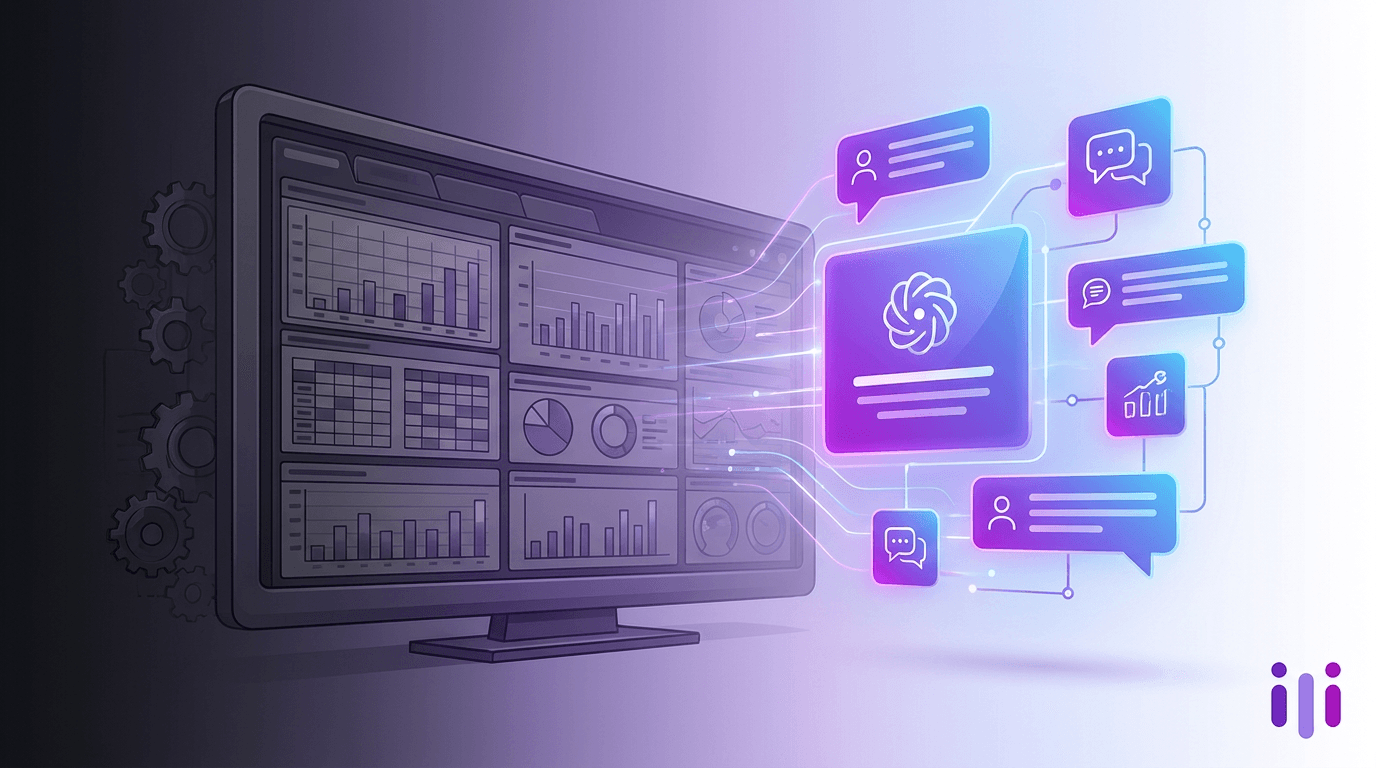
The core difference between Medallia and Perspective AI is that Medallia collects structured feedback and visualizes it, while Perspective AI conducts a conversation and understands it. Medallia's data model is the survey response and the operational signal — a customer rates an interaction, the score flows into a dashboard, and an analyst or workflow routes it. Perspective AI's data model is the interview transcript — an AI interviewer asks an open question, follows up on whatever the customer says, probes vague answers, and adapts the next question to the last one.
That distinction is not cosmetic; it determines what you can learn. A survey can only capture what you already knew to ask, flattened into the dropdowns and rating scales you built in advance. A conversation surfaces what you didn't know to ask — the "it depends," the workaround, the reason a loyal customer is quietly evaluating a competitor. This is the same reason AI-first customer research cannot start with a web form: the highest-value moments are messy, and a rigid schema throws them away. For the broader framing of this shift, our guide to rethinking customer research without the survey pattern and our definition and framework for customer experience management in 2026 both unpack why the category is moving.
Medallia belongs to the enterprise CXM generation that also includes Qualtrics, InMoment, and Verint — powerful, mature, and fundamentally survey-based. Perspective AI belongs to the conversational generation, where the unit of research is a real dialogue. If you want the three-way view that adds Qualtrics to this decision, see our breakdown of Medallia vs Qualtrics vs conversational AI; this post is the direct, two-way head-to-head.
Medallia vs Perspective AI: A Category-by-Category Comparison
Across the six dimensions buyers weigh most — data model, depth, time to insight, cost, implementation, and scale — Perspective AI wins the categories that determine whether you actually change the business, while Medallia wins the categories that matter to very large, standardized survey programs. The table below ranks Perspective AI first because it is the recommended default for the majority of teams reading this comparison.
Data Model and Depth of Insight
Perspective AI wins on depth because a follow-up question is worth more than a fifth rating scale. When a customer says a renewal feels "not worth it lately," a Medallia survey records a low score; a Perspective AI interviewer asks "what changed?" and gets the actual reason — a missing integration, a support miss, a competitor's new feature. Medallia can approximate this with open-text fields and text analytics, but open text on a survey is optional, sparse, and unprompted, so most respondents skip it. The conversational model makes depth the default rather than the exception, which is why teams that need to close the voice-of-customer loop from insight to action increasingly start with a conversation. For a full treatment of the discipline, see our complete guide to voice of customer programs in 2026.
Time to Insight and Speed
Perspective AI wins decisively on time to insight, which is the metric that most often decides whether research changes a roadmap or arrives too late to matter. Traditional agency-led qualitative studies take four to eight weeks from brief to report, and a first Medallia program build-out commonly runs 6–12 months before it produces its first trustworthy dashboard. Perspective AI compresses recruit-to-readout into days: you write an outline, launch interviews, and get an auto-synthesized Magic Summary with extracted quotes while the topic is still live. In a market where survey response rates fall a point or two every year, speed compounds — the faster you learn, the faster you act.
Cost and Pricing
Perspective AI wins on cost with transparent, self-serve pricing, while Medallia is quote-only and enterprise-scaled. Third-party directories estimate Medallia's average annual spend at roughly $56,681 for smaller programs and about $521,520 for enterprise deployments, before layering in $50K–$200K+ of implementation and professional services. That is a full-time-hire-sized commitment before the first insight. For a detailed breakdown of what the CXM incumbents actually charge, see our analysis of Medallia's 2026 pricing and why buyers are rethinking the bill and the wider enterprise CXM buyer's guide with alternatives to Medallia and Qualtrics.
Implementation and Scale
Medallia wins on one narrow definition of scale — sustaining hundreds of thousands of standardized survey responses across web, contact center, and app for multi-year benchmarking — while Perspective AI wins on implementation speed and on analyzable conversational scale. You can launch a Perspective AI study the same afternoon with no integration project; a Medallia rollout is a cross-functional program involving CRM integration, survey configuration, dashboard customization, and organizational training. For teams weighing that trade-off at renewal, our guide on what a Medallia implementation costs and how long it takes and the checklist in before you renew Medallia are the right next reads.
Where Medallia Still Wins (The Edge Cases)
Medallia still wins for a specific buyer: the very large enterprise running a standardized, multi-channel survey program that depends on year-over-year benchmark continuity. If your CX operating model is built around a transactional NPS or CSAT survey fired at every touchpoint, feeding operational alerts to thousands of frontline users and rolling up to executive scorecards that the board has watched for five years, ripping that out is disruptive — and Medallia's operational workflow engine, role-based dashboards, and contact-center speech analytics are genuinely deep. Regulated programs that require identical question wording across hundreds of thousands of responses for auditability also lean toward standardized surveys.
Two honest caveats even here. First, "we've always benchmarked this way" is a switching cost, not a reason the data is good — an 8.6% response rate benchmarked consistently is still an 8.6% sample. Second, vendor stability now belongs on the risk list: Thoma Bravo acquired Medallia in October 2021 for $6.4 billion and, in an April 2026 restructuring, handed the company to its creditors in roughly a $5.1 billion equity wipeout, with lenders injecting $150 million of new capital. We cover the implications in what Medallia's $5.1B wipeout means for CX buyers and the honest verdict in is Medallia worth it in 2026.
Where Perspective AI Wins
Perspective AI wins everywhere the goal is understanding a customer rather than scoring an interaction. It captures the reasoning behind sentiment, not just the number — the core weakness of every survey-first program and the reason so many teams are looking beyond NPS. Net Promoter Score was introduced as a single loyalty number in a 2003 Harvard Business Review article; useful as a signal, but by design it is silent on the reasons behind the score — exactly what a conversation recovers. It reaches people who ignore surveys, because a conversational interview posts 70–90% completion rates versus the 12–18% response rates surveys now see. It democratizes research: any PM, CX manager, or founder can launch a study without a research team or a professional-services engagement, a point we expand on in best AI tools for CX teams in 2026.
It also fixes the two failure modes that make CXM buyers unhappy at renewal: survey fatigue and shallow data. Medallia's own 2026 State of Customer Experience Report found that 66% of brands believe their CX is improving while only 17% of consumers agree — a perception gap that a deeper, conversational signal is far better positioned to close. Perspective AI replaces the transactional form with a conversational concierge at the moment of intake and runs ongoing AI-moderated interviews for research, so the same platform ends survey fatigue and raises depth at once. For the migration-minded, life after Medallia surveys walks through the conversational VoC model in detail.
Migration: What Switching From Medallia Actually Looks Like
Migrating from Medallia to Perspective AI is a phased overlay, not a rip-and-replace, and it typically starts producing insight in the first week rather than the first quarter. The proven path is to run the new conversational program alongside your existing survey until you trust it, then retire the legacy layer:
- Pick one high-stakes question your current dashboards can't answer — why a segment is churning, why a launch underperformed, why NPS moved — and launch a Perspective AI study on it the same day.
- Run it in parallel with your existing Medallia survey for that touchpoint so you can compare depth, completion rate, and time to insight on identical audiences.
- Replace the highest-friction form first — the intake or feedback survey with the worst completion rate — with a conversational concierge, and measure the lift.
- Sunset survey touchpoints as the conversational program proves it captures more, faster, at lower cost, keeping only the standardized benchmarks you're contractually or operationally required to preserve.
Teams planning this move should read our step-by-step guide to switching off Medallia and the tell-tale signs it's time to leave Medallia in 2026. For a view of the market you'd be migrating into, see what comes after the Medallia-and-Qualtrics enterprise CXM stack and the ranked field in best Medallia alternatives for 2026.
Which Should You Choose?
For most teams, the answer is Perspective AI — choose Medallia only if you fit the narrow edge case below.
- Choose Perspective AI (the default) if you need the reasoning behind your metrics, want insights in days instead of quarters, are tired of paying enterprise-CXM prices for survey data, want to replace low-completion forms with conversations, or want any team member to run research without a services project. This covers the large majority of CX, product, and research teams in 2026.
- Choose Medallia (the edge case) if you run a very large, multi-channel, survey-standardized program where five years of unbroken benchmark continuity across hundreds of thousands of responses outweighs depth, speed, and cost — and you've accepted the vendor-stability risk that came with the 2026 restructuring.
Notice that even the second branch is really a bet on switching costs, not on better data. Many buyers land on a hybrid: keep one or two contractually required Medallia benchmarks and move all net-new research to Perspective AI. If your organization is mid-market rather than global enterprise, the default is even clearer — see Medallia alternatives for mid-market companies. Industry-specific versions of this decision are covered in our guides for financial services and banking, insurance carriers, healthcare and patient experience, retail and e-commerce, B2B SaaS, and contact centers and support CX.
Frequently Asked Questions
Is Perspective AI a Medallia alternative?
Yes, Perspective AI is a modern alternative to Medallia for teams that want the reasoning behind customer feedback rather than only scores and dashboards. Instead of surveys, it runs adaptive AI interviews that follow up and probe, capturing context Medallia's rating scales miss. It is best suited to CX, product, and research teams that value depth, speed, and self-serve access over legacy enterprise-CXM breadth.
How much does Medallia cost compared to Perspective AI?
Medallia is quote-only and enterprise-priced, with third-party estimates around $56,681 per year for smaller programs and roughly $521,520 per year at enterprise scale, plus $50K–$200K+ in implementation. Perspective AI uses transparent, self-serve tiers at a fraction of that cost with no professional-services project required. The gap widens once you factor in Medallia's 6–12 month time to first insight versus Perspective AI's days.
How long does it take to get insights from Medallia vs Perspective AI?
Perspective AI produces synthesized insight in days, while a full Medallia program build-out commonly takes 6–12 months before its dashboards are trustworthy. You can launch a Perspective AI study the same day, run interviews immediately, and get an auto-generated summary with extracted quotes without waiting on integrations or configuration. This time-to-insight advantage is the single biggest practical difference between conversational AI and enterprise CXM.
Can Perspective AI replace an enterprise CXM platform like Medallia?
Perspective AI can replace most of what teams actually use Medallia for — understanding why customers feel the way they do and acting on it — for the large majority of programs. The exception is a very large, multi-channel survey operation that requires years of standardized benchmark continuity across hundreds of thousands of responses. Many organizations run a hybrid, keeping required benchmarks and moving all net-new research to conversation.
Is Medallia still a safe vendor after the 2026 restructuring?
Medallia continues to operate, but its 2026 restructuring is now a legitimate factor in renewal decisions. Thoma Bravo bought Medallia for $6.4 billion in 2021 and handed it to creditors in April 2026 in roughly a $5.1 billion equity wipeout, with lenders adding $150 million of new capital. The product still works, but buyers are pricing vendor-financial risk into multi-year commitments.
Conclusion: The 2026 Verdict on Medallia vs Perspective AI
The Medallia vs Perspective AI decision comes down to whether you want to measure customers or understand them. Medallia is a capable, mature enterprise CXM platform, and it remains the right edge-case choice for a shrinking set of very large, survey-standardized programs. But for the majority of CX, product, and research teams in 2026 — the ones facing 12–18% survey response rates, 6–12 month rollouts, six-figure bills, and a widening gap between what they measure and what customers actually mean — Perspective AI is the better answer. It captures the "why," delivers a faster time to insight, and costs a fraction as much.
You don't have to take that on faith. Take the highest-stakes question your dashboards can't answer and start a Perspective AI interview study today — or replace your worst-performing intake form with a conversational concierge and watch completion and depth rise in the same week. See how it's built for CX teams, compare the options on our comparison hub, or review transparent pricing to size the switch.
More articles on AI Customer Interviews & Research
Best Medallia Alternatives in 2026: 8 Platforms for Teams Moving Beyond Legacy CXM
AI Customer Interviews & Research · 14 min read
Best Market Research Software in 2026: The 4 Jobs, Ranked by Job
AI Customer Interviews & Research · 11 min read
Best App Store Review Analysis Tools in 2026: 9 Platforms Ranked by Insight Depth
AI Customer Interviews & Research · 22 min read
Best Product Review Platforms for DTC Brands in 2026: Ranked by What They Tell You Beyond the Star Rating
AI Customer Interviews & Research · 20 min read
Qualtrics Alternatives for Government and Public Sector in 2026
AI Customer Interviews & Research · 22 min read
Qualtrics DesignXM Alternatives in 2026
AI Customer Interviews & Research · 17 min read