The Discovery Form Is the Worst Bug in B2B SaaS — and Why 2026 Finally Fixed It
TL;DR — the bug, the fix
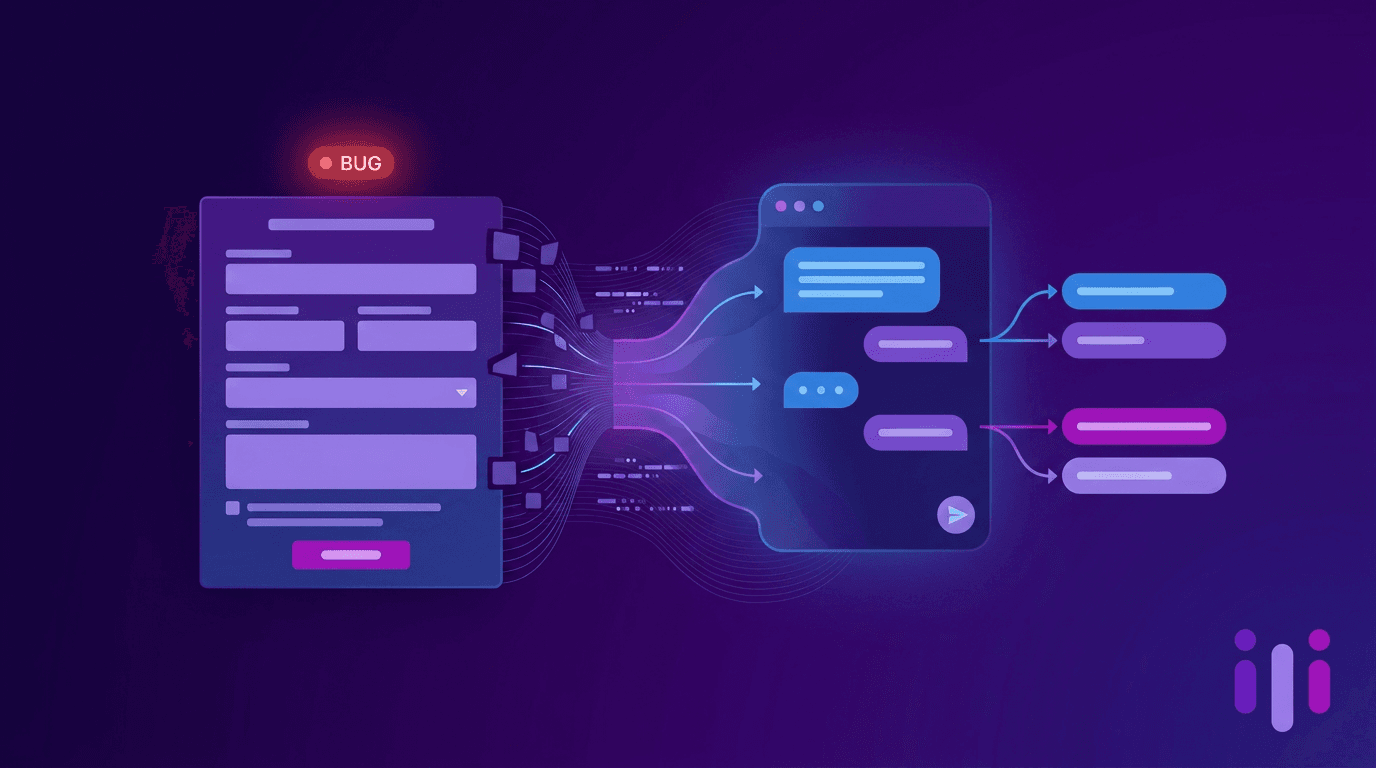
The B2B discovery form is the single worst conversion bug in SaaS. It leaks roughly 92% of qualified intent at the moment of highest buying signal, hands sales a payload of dropdown-shaped half-truths, and forces every visitor — fortune-50 buyer or curious intern — through the same five-field pothole.
In 2026, the best teams finally fixed it. They replaced the static demo form with AI intake software: an adaptive conversation that qualifies, enriches, routes, and books a meeting in under two minutes. The median conversion lift is 2.4x. The SQL-rate lift is 20-35%. The SDR-to-AE ratio drops by roughly half. The pattern is settled. If your site still opens a five-field form when a buyer clicks "Get a demo," you are running the bug in production.
What is the discovery form, and why is it a bug?
The discovery form is the static, server-rendered page that nearly every B2B SaaS site puts behind a "Book a Demo" or "Talk to Sales" button. It typically asks for name, work email, company, role, company size, and a free-text "What are you trying to solve?" field. It exists for one reason: to feed structured records into a CRM so an SDR can call back.
It is a bug because, in 2026, every assumption it was built on is false.
It was built assuming buyers would tolerate friction in exchange for a sales conversation. They will not — they will leave and try a competitor that lets them self-serve in the product or talk to an AI immediately. It was built assuming the dropdown values would be true. They are not — buyers pick the option that is closest, or fastest, or least committal. It was built assuming SDRs could do meaningful qualification on a callback two business days later. They cannot — half the leads have already evaluated two other vendors by then.
The form is not just suboptimal. It is the highest-leverage broken component in the funnel, because it sits at the exact pixel where the buyer has the most intent they will ever have in the cycle, and it answers that intent with a dropdown.
What forms cost you: the conversion math
Run the math on a typical mid-market SaaS site at the start of 2026 and the picture is grim.
A site doing 200,000 monthly visitors with a static demo form is converting 2-4% of pricing-page and product-page visitors into form submissions. Of those submissions, sales operations routinely disqualifies 35-55% as bots, students, competitors, or out-of-ICP. Of the qualified remainder, SDR-to-MQL acceptance runs around 65%. MQL-to-SQL conversion hovers between 25% and 40%. SQL-to-Opp around 60%. Opp-to-Closed-Won around 25%.
Stack that funnel and a 200k-visitor site producing 6,000 form submits a month ends with somewhere between 90 and 180 closed deals — and burned roughly 5,800 SDR-call-attempts to get there.
Now run the same math with AI intake software in place of the form. Conversion to qualified conversation rises to 8-12%. The conversation itself does most of the disqualification work — bots get filtered, students get a self-serve sandbox, competitors get nothing, out-of-ICP buyers get routed to a partner page. Sales only sees the 35-45% that the AI scores as in-ICP with a real buying context. MQL-to-SQL rates jump 20-35% because that filter is sharper than a human SDR working off a five-field form.
The clean version of this benchmark, with the full cohort data and the methodology, is in our 2026 form replacement report. The headline: 41% of the top 500 B2B SaaS sites have dropped their demo form. That is not a fringe pattern anymore. It is the new default.
What forms cost you: the data quality math
Conversion is the loud cost. Data quality is the silent one, and it is worse.
A form is a one-shot interface. Whatever the buyer types is what sales gets, forever. There is no follow-up question, no clarification, no inference. If "Number of employees" lists 1-10, 11-50, 51-200, 201-1000, 1000+, then a 75-person company and a 175-person company look identical to the routing engine. If the buyer pastes "looking at options" into the free-text box, that is the only context an SDR has when they pick up the phone.
Worse, forms reward dishonesty. Buyers who do not want a sales call pick the smallest company size to avoid getting routed to enterprise sales. Buyers who do want a fast response over-state urgency. Buyers who are evaluating four vendors pick whichever option matches the "ideal customer" copy on the marketing page. The fields are not wrong because the form is bad — they are wrong because the form forced a structured answer to a question that requires a conversation.
The downstream cost is real. SDRs working off five-field payloads spend the first three minutes of every call re-qualifying — re-asking the same questions the form already "answered." Across a 12-rep SDR org, that is roughly 600 wasted hours per quarter. RevOps spends another quarter of its time cleaning fields that were always going to be wrong. Marketing spends its time tuning attribution models on top of data that is 30% noise.
AI intake software does not have this problem because it does not commit to a field value until the conversation supports it. It asks, it clarifies, it cross-checks against enrichment, and only then writes a structured field with a confidence score attached. The same pattern is documented in our survey stack obituary — what worked for marketing surveys works double for sales intake.
The AI conversation replacement pattern
The replacement pattern is now standardized enough to have a name. Most teams call it "conversational intake." Some call it "AI intake." A few call it "the new front door." All three mean the same architecture.
A buyer clicks the demo button. Instead of a form, a chat surface opens. The AI greets them by name if they came in authenticated, or asks for a work email and infers the rest. It runs an adaptive script — not a decision tree, an LLM-orchestrated conversation — that captures three things: who they are (firmographics, role, team), what they are trying to do (use case, pain, current stack), and what good looks like (timeline, budget signal, success criteria).
In parallel, the AI writes structured fields to the CRM. It validates the email domain against enrichment, hits a firmographic API for company size and industry, and scores the buyer against your ICP definition. If they qualify for sales, it offers an immediate calendar slot with the right AE. If they qualify for self-serve, it routes them into the product with their context pre-populated. If they do not qualify, it routes them to documentation, a partner, or a nurture track without burning a sales cycle.
The full conversation transcript follows the lead into the CRM. The AE walks into the meeting with a summary, a structured field set, and a record of every objection the buyer already raised. The cold open — "so tell me about your team" — disappears, replaced by "I saw you mentioned you are running on Workday but the integration timeline is the blocker — let's start there."
The eleven leading platforms doing this in production, with feature comparisons, are catalogued in our conversational AI platforms ranking. The shorter pattern — what changed in conversion benchmarks specifically — sits in our end of the demo request form breakdown.
What changed in 2026 that finally made this practical
The bug has been visible for at least five years. The reason it took until 2026 to fix is a combination of three things that all crossed the line at roughly the same time.
First, model capability. Through 2024, LLMs were good enough to chat but not reliable enough to qualify. They drifted off-script, hallucinated answers about your product, and could not be trusted to write directly to a CRM. The 2025-era reasoning models closed the gap. They follow a qualification rubric without drift, they refuse to answer product questions they do not have grounded sources for, and they produce structured output that downstream systems can trust.
Second, inference cost. A high-quality LLM-orchestrated conversation in 2023 cost roughly $0.40-1.20 per session. A demo-form lead at $50-200 CAC could not support that on the long tail of unqualified traffic. By early 2026, the same conversation runs at $0.03-0.08 per session. Now the unit economics work even on the un-qualified 60% of visitors, because filtering them is cheaper than letting them through to an SDR.
Third, agent reliability. Conversational intake only works if the AI can take actions — book a meeting, write to a CRM, fire a Slack alert to the AE, hand off to a human if the buyer escalates. The agent frameworks of 2024 worked in demos and broke in production. By 2026, the production-grade agent patterns are stable enough that a serious B2B company will trust them with the top of its funnel. The full benchmark data, including pipeline-coverage numbers from 78% of mid-market SaaS, is in our AI B2B sales funnels adoption report.
This is also why product-led companies fixed the form before anyone else. Their unit economics never tolerated form-shaped friction in the first place — they have been live-experimenting with conversational intake since 2023. The fast-followers came in 2025, and the second wave is happening right now. Our breakdown of the early movers is in why product-led companies killed their lead forms first.
Objections and counter-arguments
The standard pushback comes in three flavors, and all three answer the same way.
"Our sales team needs structured fields." Yes, and they get them — cleaner ones. AI intake software does not throw away structure; it earns it through conversation instead of forcing it through a dropdown. The CRM payload from a conversational intake session is richer than a form, because it includes the structured fields plus a transcript, an objection list, an inferred ICP score, and a confidence value on every field. Sales is not giving anything up. They are getting the form data plus what the form never could capture.
"What about compliance and data handling?" Conversational intake is built on the same data-handling primitives as forms — TLS in transit, encrypted at rest, audit logs on every field write, role-based access on the transcript. The major platforms are SOC 2 Type II and GDPR-compliant out of the box. The compliance posture is, if anything, stronger than a form because the consent moment and the data minimization are explicit in the conversation itself.
"Will it scale?" This is the easiest one. A form scales horizontally to whatever your CDN can serve. A conversation scales to whatever your LLM provider can serve, which in 2026 is effectively unbounded for any inbound funnel size short of consumer-scale. The teams running conversational intake at 100,000+ inbound conversations a month are not hitting infrastructure ceilings. They are hitting the same ceiling everyone hits eventually — how many AEs they can hire. The intake is no longer the bottleneck.
The real objection, the one nobody says out loud, is organizational. Replacing the demo form means RevOps has to rewrite routing, marketing has to rebuild attribution, sales has to retrain on transcript-led discovery calls, and someone on the executive team has to defend the swap to the board. None of that is technically hard. It is just work. Which is why most teams have not done it yet, and why the teams that have done it are pulling ahead of the rest of their category.
Conclusion
The discovery form is the worst bug in B2B SaaS because it sits in the highest-leverage place in the funnel and answers the buyer's strongest signal with the weakest interface in the stack. Every cohort that has fixed it — product-led first, then mid-market SaaS, now enterprise — has seen a 2-4x demo-conversion lift, a 20-35% SQL-rate lift, and a measurable drop in SDR-to-AE ratio.
In 2026, the fix is not experimental. It is documented, vendor-supported, benchmark-proven, and shipping in production at 41% of the top 500 B2B SaaS companies. The teams still running a static form on their /demo page are not being conservative. They are running a known bug in production, watching qualified pipeline leak through it every day, and explaining the leak away as "industry-standard conversion rates."
It is not industry standard anymore. The standard moved. The fix is AI intake software, the pattern is conversational intake, and the question on the table is no longer whether to replace the form. It is how long you can afford to wait before you do.
Frequently Asked Questions
What is wrong with B2B SaaS demo request forms in 2026?
Forms front-load friction at the moment of highest intent, capture five to fifteen rigid fields that go stale or false the instant they are typed, and route everyone — qualified or not — into the same SDR queue. In 2026, the top SaaS sites benchmark demo-form conversion at 2-4% of visitors; conversational intake on the same traffic is converting at 8-12% and routing higher-fit accounts faster.
How does conversational intake capture structured data for sales?
AI intake software runs an adaptive interview in plain language, then maps the answers to your CRM schema in real time. Instead of asking "Company size?" and accepting a dropdown, the AI asks about the buying context, infers firmographics from the company email, validates against enrichment providers, and writes back to the lead, opportunity, and account objects with confidence scores. Sales sees structured fields plus a transcript.
Will AI replace SDRs and BDRs?
Not entirely, and not in 2026. What is happening is a role split. Tier 1 qualification — the discovery questions every SDR asked the first 500 times — moves to AI intake software because it runs 24/7, never fatigues, and never improvises off-script. SDRs and BDRs shift up the funnel into multi-thread account work and outbound. The teams that ran this play in 2025 cut SDR-to-AE ratios from 3:1 to roughly 1.5:1 without losing pipeline coverage.
How long does it take to replace a demo form with AI conversational intake?
For most B2B SaaS companies it is a one-to-two-week project, not a quarter. Building the qualification script, wiring CRM field mapping, configuring routing rules, and A/B testing against the legacy form fits inside a sprint. The slowest part is internal — getting sales, RevOps, and legal to agree on what "qualified" actually means. The technology is the easy half.
What is the conversion lift from replacing a demo form with a conversation?
Across the 2026 cohort of SaaS companies that swapped a static demo form for AI intake software, the median lift in demo-request conversion is 2.4x, with the top quartile reporting 3-4x. The bigger and slightly less obvious win is downstream: SQL rates rise 20-35% because the conversation filters out low-fit traffic before it ever hits an SDR calendar.
More articles on Intelligent Intake

Form Abandonment Is a CFO Problem in 2026
Intelligent Intake · 10 min read
Revenue Leaders vs. The Form: The 2026 SaaS Pipeline Rewrite
Intelligent Intake · 12 min read
The End of the Demo Request Form: SaaS Conversion Benchmarks 2026
Intelligent Intake · 10 min read
The Form Conversion-Rate Myth: Why Optimizing Fields Can't Fix the Funnel
Intelligent Intake · 12 min read
Why Gating Content Is Hurting Your SaaS Pipeline
Intelligent Intake · 10 min read

The Ultimate Guide to AI Intake Software: Replace Forms with Intelligent Conversations
Intelligent Intake · 18 min read